Unlocking Smarter Advertising with Ad Creative AI
Discover how ad creative AI transforms your campaigns. Learn to create high-performing, data-driven ads at scale with this comprehensive guide.
Imagine having a creative partner who never sleeps. One who has the strategic mind of a data analyst and the visual flair of a top-tier designer. That's the core idea behind ad creative AI. It’s technology built to generate and test countless ad variations at a scale that's simply impossible for a human team to match.
This is how your marketing can finally move beyond guesswork and into the realm of data-driven precision.
What Ad Creative AI Is and Why It Matters
Let's get one thing straight: ad creative AI is about supercharging human talent, not replacing it. Think of it as a powerful assistant that sifts through thousands of your past ad campaigns, learning what really grabs your audience's attention. It pinpoints the exact colors, images, and headlines that drive clicks and conversions.
This isn't some far-off, futuristic concept. It's a practical tool for marketers who are tired of creative burnout and the relentless demand for fresh content. Its job is to generate a massive volume of ad variations, making sure your message connects perfectly with every single audience segment. To really get a handle on its impact, it helps to understand the bigger picture of artificial intelligence personalization and how it's reshaping modern marketing.
Moving From Guesswork to Precision
In the past, making ad variations was a slow, manual grind. A marketing team would create a handful of ads, launch them, and just hope for the best. Ad creative AI completely flips that model on its head by automating the creation of hundreds—or even thousands—of creatives.
This shift means you can deliver the right creative, to the right person, at the right time—every single time. Advertising is no longer a broad-stroke effort; it becomes a highly targeted, personal conversation with each potential customer.
Why does this matter so much? Because personalization isn't a "nice-to-have" anymore. It's an expectation. People are drowning in ads, and generic messages get tuned out instantly. AI-driven creatives cut through that noise by being hyper-relevant.
Key Advantages for Modern Brands
Bringing an ad creative AI platform like ViewPrinter into your workflow unlocks more than just the ability to make more ads. It gives you a serious competitive edge.
- Speed Up Production: You can drastically shrink the time it takes to go from a simple idea to a live campaign. No more creative bottlenecks slowing down your growth.
- Boost Performance: The AI is always testing and learning, identifying your top-performing ads in real-time. This helps you put your budget where it will get you the best possible ROI.
- Get Smarter with Data: It gives your creative team real insights into what resonates with your audience. This frees them up to focus on big-picture strategy and truly innovative ideas.
At the end of the day, ad creative AI empowers you to build more effective, efficient, and impactful campaigns that drive real, measurable results for your business.
How Ad Creative AI Actually Works
So, how does this stuff really work under the hood?
Think of it like a creative team on overdrive: you have a tireless artist paired with a brutally honest art critic. The artist churns out new designs, and the critic immediately tells them what works and what doesn't. They go back and forth, refining the work until it's perfect. This is the core idea behind Generative Adversarial Networks (GANs), one of the key technologies powering modern visual AI.
These networks are the engine that creates the stunning visuals. One part, the generator, is the artist creating the content. The other, the discriminator, is the critic, evaluating those creations against a massive library of real-world examples. This constant tug-of-war pushes the AI to produce incredibly realistic and compelling images that feel like they were made by a human.
At the same time, another piece of the puzzle, Natural Language Generation (NLG), steps in as the AI's copywriter. NLG models sift through mountains of high-performing ad copy, learning what words, phrases, and tones actually get people to click. They then write compelling headlines and CTAs tailored to your audience and campaign goals.
The Core AI Workflow
The whole process isn't just random magic; it's a logical system that turns raw data into ads that perform. It's a clean workflow designed to get from point A (data) to point B (optimized creative) without the usual friction.
This visual breaks down the typical journey inside an ad creative AI platform, showing how it analyzes, generates, and personalizes content for your audience.
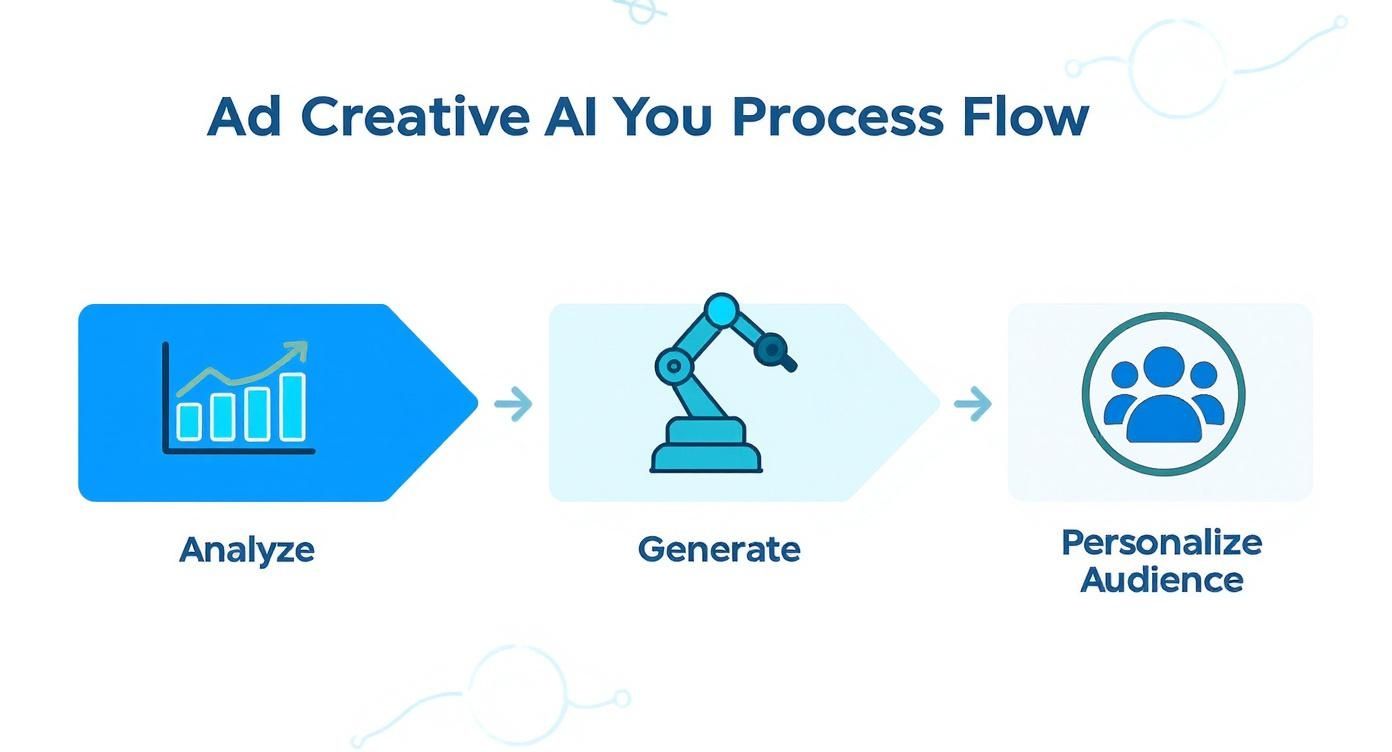
As you can see, it all starts with analysis, moves into generation, and ends with personalization, creating a feedback loop that helps the system get smarter over time.
This structured approach is quickly becoming the new normal. It’s no surprise that nearly 98% of marketing leaders expect to be using AI for better customer engagement by 2025. This shift is leaving behind the old spray-and-pray methods where targeting was broad and making changes took forever. You can dive deeper into how AI is enabling this level of personalization by learning about the future of AI in advertising on maticdigital.com.
The process starts with the AI ingesting vast amounts of historical campaign data—clicks, conversions, engagement rates, and more. It identifies hidden patterns in successful creatives and uses those insights to generate a huge volume of new ad variations. Finally, it predicts which ones will perform best before you spend a single dollar.
Platforms like ViewPrinter handle this entire workflow for you. Once you feed the system your brand assets and past performance data, it gets to work:
- Analyze Past Performance: The AI learns which visuals, colors, and copy have actually connected with your audience before.
- Generate New Variations: Based on those data-backed insights, it creates hundreds of new creative options to test.
- Predict Future Success: The system then scores each new creative, giving you a clear signal on which ones to launch for the highest chance of success.
The True Benefits of Using Ad Creative AI
Bringing ad creative AI into the mix isn't just about churning out more ads, faster. It's about completely rewriting the rules of how you connect with your audience and measure what actually works. This shift brings three huge advantages that directly boost your bottom line, supercharge your efficiency, and make your entire marketing operation more nimble.
Hyper-Personalization at Scale
Let's be real: creating genuinely tailored ads for dozens of niche audiences has always been a logistical nightmare. It took so many resources that most brands just settled for one-size-fits-all messaging. AI completely shatters that limitation.
Imagine a shoe brand launching a new sneaker. Instead of one generic ad, an ad creative AI can spit out thousands of unique versions in minutes. It can serve up ads showing specific colorways to people who’ve viewed them before, talk up durability to the hiking crowd, and craft entirely different copy for streetwear fans versus serious athletes. That level of granular targeting used to be a fantasy. Now, it's a core function.
Accelerate Your Creative Production
Creative bottlenecks are the silent killer of campaign momentum. The endless back-and-forth between designers, copywriters, and strategists can drag a simple ad's production from a few days to a few weeks. That snail's pace means you’re missing out on trends and your audience is getting bored with stale ads.
Ad creative AI hits the fast-forward button on this entire workflow. By automating the grunt work—resizing assets, remixing elements, and drafting initial copy—it frees up your team to focus on big-picture strategy and genuine innovation.
Instead of getting bogged down in manual tweaks, your team can simply review and approve AI-generated options. We've seen this cut production time by as much as 90%. That speed means you can launch campaigns faster, jump on market trends the moment they happen, and fight off ad fatigue with a constant flow of fresh creative.
To give you a clearer picture, here’s a quick breakdown of how the old way stacks up against the new.
Table: Traditional Creative Workflow vs Ad Creative AI Workflow
| Stage | Traditional Process (Time & Effort) | Ad Creative AI Process (Time & Effort) | | :--- | :--- | :--- | | Briefing | Days to weeks of meetings and revisions. | Minutes to input key objectives and audience data. | | Concepting | Days of brainstorming; limited to a few core ideas. | Seconds to generate hundreds of creative concepts and angles. | | Design & Copy | Weeks of manual design and copywriting cycles. | Hours to generate, review, and refine complete ad sets. | | Variations | Extremely time-consuming; often skipped. | Automated; generates thousands of variations for A/B testing. | | Launch | Slow, manual campaign setup. | Fast, often integrated directly with ad platforms. | | Optimization | Weeks of monitoring; manual budget shifts based on limited data. | Real-time, automated budget allocation to top-performing ads. |
The difference is night and day. You're moving from a slow, linear process to a fast, iterative one.
Achieve Data-Driven Performance Optimization
This might be the most powerful benefit of all: moving from creative based on gut feelings to creative driven by hard data. AI doesn't just make ads; it tests them, relentlessly. It can run hundreds of A/B tests at the same time, finding the winning combinations of images, headlines, and calls-to-action with total statistical confidence.
This isn’t a one-and-done thing, either. It’s a continuous, automated loop. The AI watches performance in real-time, automatically pushing your budget toward the ads that are actually delivering the best click-through rates and conversions. This smart allocation makes sure every dollar you spend is working as hard as it possibly can, maximizing your ROI.
This is especially true for more complex formats. Our guide on creating powerful AI video ads dives deep into how this kind of optimization can completely transform campaign results.
Ultimately, the AI learns from every single click and conversion, making each new campaign smarter and more effective than the one before it.
Seeing Ad Creative AI in Action
Alright, let's move past the theory and look at what this stuff actually does in the real world. This is where you see the true power of ad creative AI—turning abstract ideas into real, measurable growth for businesses.
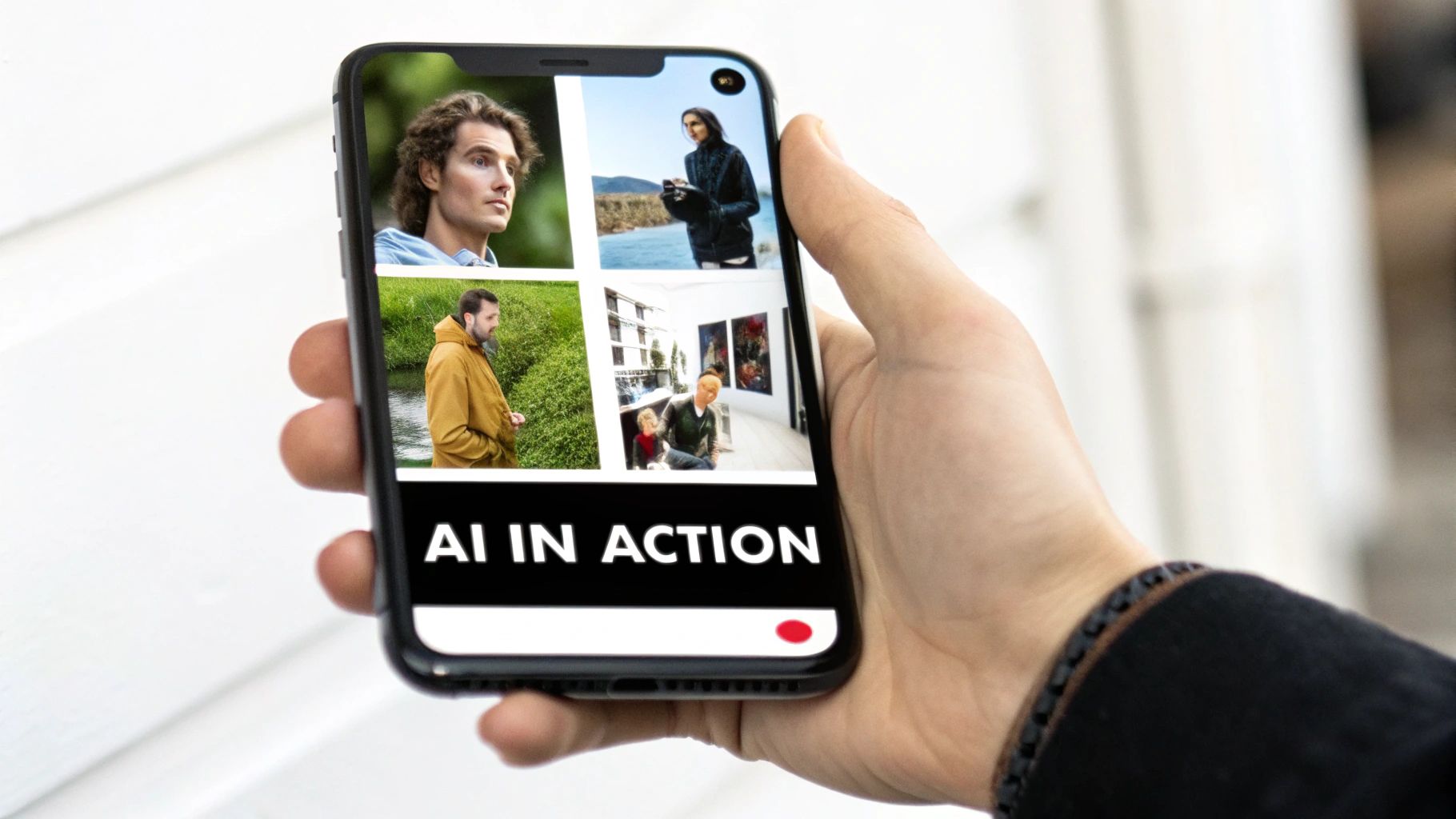
Think about an e-commerce brand that’s done with one-size-fits-all ads. They’re now using AI to spin up dynamic social media posts that automatically sync with their inventory. Even better, these ads can show a shopper the exact pair of shoes they were just looking at a minute ago.
That’s the kind of relevance that gets people to click "buy."
The sheer scale of this is hard to wrap your head around. Since 2022, people have created over 15 billion AI-generated images. It took traditional photography about 149 years to hit that same milestone. With an estimated 34 million new AI images popping up daily, the ad world is changing right before our eyes. If you want to dive deeper into the numbers, digitalsilk.com has some great AI stats.
From Retail to B2B Applications
And this isn't just a game for direct-to-consumer brands.
Imagine a travel company serving up personalized video ads that feature the exact destinations you’ve been Googling. By pairing stunning visuals with an offer made just for you, that dream vacation suddenly feels too good to pass up. You can bet their booking rates go up.
Even in the B2B world, a software company can use AI to A/B test a dozen different value propositions in its LinkedIn ads. The system quickly figures out what messaging clicks with a CTO versus what a project manager wants to hear, which means less wasted ad spend and shorter sales cycles.
These aren't just pie-in-the-sky ideas; they're happening right now. The common thread is a move away from making a handful of ads to generating a massive volume of smart, data-backed variations that learn and adapt.
The Tangible Business Impact
At the end of the day, what matters is the impact on the bottom line. And the results are clear, hitting the KPIs every marketer obsesses over.
- Skyrocketing Conversion Rates: When you show people hyper-relevant ads, they click. And they buy. It’s that simple.
- Significant Ad Spend Reduction: The AI spots the winning creatives and puts the budget behind them, cutting out the waste from underperforming ads.
- Enhanced Creative Insights: You get hard data on what visuals, headlines, and calls-to-action actually work, which informs your entire marketing strategy.
Platforms like ViewPrinter make this possible without needing a team of data scientists. The tech handles the heavy lifting of generating countless ad variations—even entire campaigns of AI-generated commercials—so your team can focus on big-picture strategy instead of tedious production work. It's a straight line to more effective advertising and a healthier bottom line.
How to Weave Ad Creative AI Into Your Strategy
Bringing ad creative AI into your workflow is easier than ever, but you need a smart approach to really make it work. It's not about just flipping a switch; it's about building a more intelligent, data-backed creative engine for your brand. First things first: define a clear, measurable goal.
Are you trying to beat creative fatigue with a constant flow of fresh ads? Maybe your click-through rates are in a nosedive and you need to find messages that actually connect with people. Your goal will shape which tools you pick and how you track your success. If you're just starting, looking into the best AI tools for marketing can give you a solid overview of the landscape.
Get Your Data and Brand Assets in Order
An ad creative AI is only as good as the information you give it. Before you even start, you need to get your house in order. That means having clean, high-quality performance data from your past campaigns. Without that history, the AI is just guessing in the dark.
Your brand assets are just as critical. We're talking logos, product shots, specific fonts, and your exact color palette. A neatly organized asset library is absolutely essential for the AI to generate content that looks and feels like your brand.
Think of it like this: you're giving a chef all the right ingredients. The better your assets and data, the more delicious and on-brand the final creative will be.
Start Small, Think Big, and Bring Your Team Along
Don't try to boil the ocean. Jumping into a massive, company-wide rollout is a recipe for headaches. Instead, start with a pilot project. Pick one campaign or a specific product line to test out the technology. This lets you prove its value to your team and other stakeholders in a controlled way. A win here builds the momentum you need for wider adoption.
Most importantly, treat the AI as a collaborator, not a replacement. This is a non-negotiable for getting your team on board.
- Empower Your Creatives: The AI can take over the mind-numbing task of creating dozens of ad variations.
- Elevate Your Strategy: This frees up your team to focus on what they do best—big-picture strategy, brand storytelling, and digging into the subtle insights that only a human can catch.
This collaborative approach makes the whole process feel like a strategic upgrade. Your team stays in control, using the ad creative AI to execute ideas faster and test concepts at a scale that was once impossible. It's the perfect partnership, blending human ingenuity with machine efficiency to create smarter, harder-working ads.
The Future of AI in Advertising
What we're seeing now with ad creative AI is just the beginning. We’re hurtling toward a future of fully autonomous campaigns, where smart systems handle everything from brainstorming the initial concepts to allocating budgets and optimizing performance in real-time.
Imagine an AI that doesn't just create a static ad but integrates seamlessly with augmented reality, letting people physically interact with your brand. That's how we'll build deeper, more lasting connections with customers. As these tools get smarter, the job of a marketer is bound to change.
The New Role of Human Marketers
Instead of getting bogged down in the day-to-day grind, we’ll become the strategic directors of these powerful AI systems. Our job will be to steer the ship, providing the kind of brand guidance and emotional intelligence that an AI can't replicate. We'll be there to catch the subtle cues and ensure the brand's voice and integrity shine through.
The future isn't about humans versus machines; it's a powerful partnership that will lead to advertising that is more relevant, engaging, and valuable for everyone involved.
As this technology grows, understanding the nuanced debate of AI art versus human art becomes crucial for staying ahead of trends and navigating the ethical questions that will inevitably come up. This strategic oversight is where we'll provide the most value.
A Data-Driven Glimpse Ahead
This isn't just a far-off dream; the industry is already moving in this direction. A recent global survey found that 59% of marketers believe AI-powered personalization is the single most impactful trend shaping our work.
On top of that, 46% of firms are already using AI's predictive analytics to get a jump on what consumers will do next. This isn't science fiction anymore. It's the new reality, paving the way for a smarter, more effective era in advertising.
Got Questions About Ad Creative AI?
Whenever a powerful new tool comes along, it’s natural to have questions. If you’re thinking about bringing ad creative AI into your workflow, you’re not alone. Let's tackle some of the most common concerns and clear up how this tech actually works.
One of the first things people ask is, "Will AI take my job?" The short answer is a hard no. It’s better to think of AI as a super-powered assistant, not a replacement for human creativity.
It’s built to handle the repetitive, soul-crushing tasks that bog down creative teams—things like resizing an ad for ten different platforms or churning out 50 minor variations for an A/B test. This frees up your designers and copywriters to focus on what they do best: thinking up big ideas, crafting compelling stories, and defining brand strategy. The AI does the grunt work; your team provides the creative spark.
Is This Only for Big Companies with Deep Pockets?
Another myth is that ad creative AI is a luxury only massive corporations can afford. That might have been true a few years ago, but today, things are different. Modern platforms have made this technology surprisingly accessible for businesses of all sizes.
Cloud-based tools like ViewPrinter run on a simple subscription model. You don't need a huge upfront investment or a server room to get started. This puts game-changing AI tools within reach for everyone, from solo founders to growing startups looking to scale their creative output without hiring a massive team.
What Does the AI Need to Get Started?
For an AI to start creating magic, you have to give it the right ingredients. The system learns from the data you feed it, so the quality of your input directly affects the quality of its output.
Think of it this way: the AI studies your past wins to predict your future successes. It needs a solid foundation of historical ad performance data, clear audience profiles, and an organized library of your brand assets to start generating creatives that actually work.
Here’s what you’ll typically need to provide:
- Performance Data: Metrics from past campaigns (clicks, conversions, engagement) teach the AI what your audience loves.
- Brand Assets: Your logos, product shots, color palettes, and fonts ensure everything it creates looks and feels like your brand.
- Audience Insights: A clear picture of your target customer helps the AI tailor its messaging for maximum impact.
How Do You Keep AI-Generated Ads On-Brand?
This is a huge one. The key is setting clear boundaries from the start. Most platforms, including ViewPrinter, let you build a "brand kit." You simply upload your logos, fonts, specific color codes, and any messaging rules you have.
From that point on, the AI uses this kit as its single source of truth. Every ad, every graphic, every piece of copy it generates will stick to your brand identity. Of course, a human touch is still vital. The best workflow is a partnership: let the AI generate a bunch of options in minutes, then have a creative director give the final sign-off. It’s the perfect mix of machine speed and human judgment.
Ready to see what ViewPrinter can do for your creative process? Stop guessing and start generating high-performing, on-brand ads in a fraction of the time. Explore our AI-powered tools and see how you can scale your social media content like never before.