How to Create Ads with AI The Definitive Guide
Discover how to create ads with AI that drive real results. This definitive guide covers strategy, creation, and optimization for your next campaign.
When we talk about creating ads with AI, we're really talking about using smart software to churn out ad copy, images, and videos at a ridiculous speed. This isn't just a minor upgrade; it's a complete shift from the slow, manual creative slog to automated, data-driven campaign creation. Think producing hundreds of ad variations in minutes, not weeks.
The New Reality of AI in Ad Creation
Welcome to the new standard for advertising. AI isn't some futuristic concept anymore—it's a core tool in the creative workflow. For marketers and business owners, accessible AI tools are completely overhauling how we develop compelling ads, leaving the old ways in the dust. In a world that demands hyper-personalized content on a massive scale, slow and manual processes just can't keep up.
AI brings a powerful mix of speed, data-backed precision, and creative variety that gives you a serious leg up on the competition. Instead of pouring weeks into a single ad concept, you can now generate dozens of high-quality options in a single afternoon.
This isn't just another trend. It's a direct response to a massive change in both technology and consumer habits. The meteoric rise of generative AI has shaken up the entire advertising world. As of 2025, the generative AI market is already valued at a staggering $63 billion—that's bigger than the entire US video gaming industry.
Just look at the adoption rates. Tools like ChatGPT hit 1 million users in just 5 days and now pull in billions of monthly visits. This signals a tectonic shift in how brands have to think about creating ads to actually reach their audience.
From Manual Labor to Intelligent Automation
So, what's the real difference between the old way and the new way? It all comes down to efficiency and scale.
The traditional path was a grind. It involved long brainstorming meetings, expensive and slow design cycles, and very limited A/B testing because of how resource-intensive it was. The AI-powered approach automates all that heavy lifting. This frees you up to focus on what really matters: strategy and analysis, not tedious production work.
To put this into perspective, let's break down the fundamental shifts in the advertising process. The table below compares the traditional methods with modern AI-powered approaches.
How AI Is Changing Ad Creation
| Aspect | Traditional Approach | AI-Powered Approach | | ---------------------- | ------------------------------------------------------ | ------------------------------------------------------------------ | | Idea Generation | Manual brainstorming, small team input | AI-driven concept generation, analyzing millions of data points | | Content Creation | Slow, requires designers and copywriters for each asset | Instant generation of copy, images, and videos in multiple formats | | Personalization | Broad audience segments, limited variations | Hyper-personalization at scale for individual user preferences | | Testing & Iteration| A/B testing a few concepts due to high costs | Mass testing of hundreds of ad variations simultaneously | | Time to Launch | Weeks or months | Hours or days |
As you can see, AI isn't just making the old process faster—it's creating an entirely new, more dynamic workflow. It moves the focus from manual creation to strategic oversight.
This infographic really drives the point home, showing just how streamlined the process becomes when you create ads with AI compared to the conventional workflow.
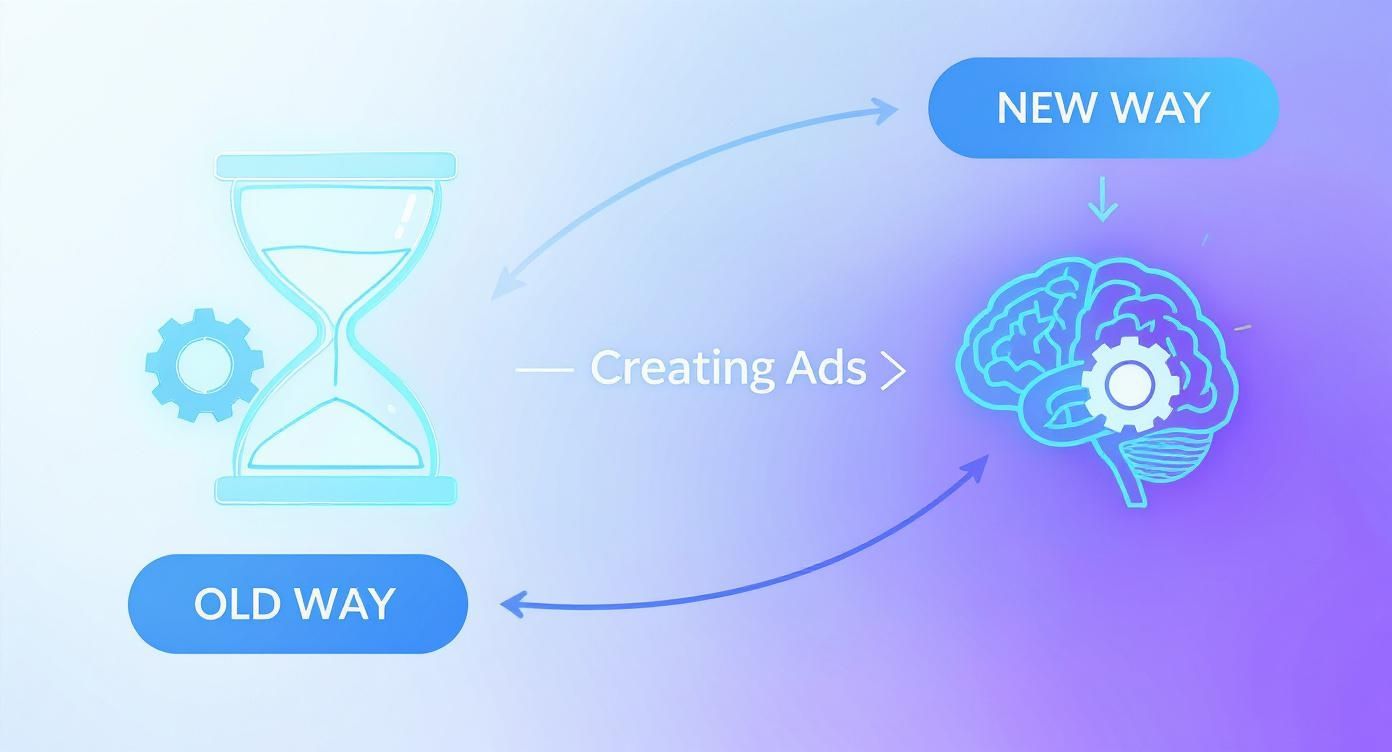
The visualization makes it crystal clear how AI collapses multiple, time-sucking steps into one efficient generation phase. To get a better handle on what’s happening across the industry, it’s worth exploring the broader range of top digital marketing AI tools available.
Think of this section as the "why." Now that you understand the massive shift that’s happening, we’ll get into the practical, step-by-step "how-to" in the sections that follow.
Laying the Foundation for Your AI Ad Campaign

It’s tempting to jump right in and start generating flashy ad copy and visuals, but that's a surefire way to get generic, off-brand results. Before you even think about hitting "generate," you need a solid plan. This is where you translate what's in your head—your business goals—into clear instructions that will guide the AI to create ads that actually work.
Think of it like briefing a new hire. The AI needs to know what you're trying to do, who you're talking to, and what your brand is all about. Without that context, you’re just guessing.
What’s the Goal? Defining Your Campaign Objectives
First things first: get laser-focused on your primary goal. Are you trying to get your name out there and build brand awareness? Or are you looking for qualified leads? Maybe you're trying to drive direct sales for a new product launch.
Each of these goals requires a completely different creative angle and call-to-action. Nailing this down from the start will shape every prompt you write and every creative the AI spits out.
- Brand Awareness: Your focus should be on captivating visuals and great storytelling.
- Lead Generation: The messaging needs to revolve around a valuable offer, like a free ebook or a spot in a webinar.
- Direct Sales: This is all about hitting on product benefits, creating a sense of urgency, and having a crystal-clear "Shop Now" call-to-action.
Getting this right prevents the AI from producing vague content that doesn't push your audience to do anything. You can find some of the best AI tools for marketing to help at different stages, but the strategy has to come from you.
The real magic of AI in advertising isn't just about speed. It's about executing a well-defined strategy at scale. Fuzzy inputs will always lead to fuzzy outputs, which is a great way to waste time and money.
Feeding the Machine: Audience and Brand Inputs
Once you know your objective, it's time to gather the raw materials that will make your AI-generated content feel authentic and connect with the right people. This means having your brand identity locked down and your audience personas ready to upload.
Your Brand Assets Checklist:
- Logo Files: Have high-resolution versions ready for different backgrounds.
- Color Palette: Be specific. Provide the exact hex codes for your primary and secondary brand colors.
- Font Guidelines: List the typefaces you use for both headlines and body copy.
- Brand Voice & Tone: Define your brand’s personality. Are you witty and informal, or professional and authoritative? Empathetic or bold?
This isn't just busywork. You're essentially training the AI to become an extension of your brand. It's no wonder that 88% of marketers are now using AI in their daily roles. They’re leaning on its ability to process these inputs and churn out highly targeted content—a skill that’s completely dependent on the quality of the data you give it. Read more about these trends in AI marketing statistics to see just how common this is becoming.
By providing these foundational elements, you ensure that every single ad is instantly recognizable and perfectly in sync with your brand.
Generating Ad Creatives That Actually Convert
Alright, you've done the strategic legwork. Now for the fun part: actually creating the ads. This is where we take all that planning and use a tool like ViewPrinter to spin up compelling ad creatives from scratch. The real secret here isn't just using AI; it's moving beyond lazy, generic prompts to get results that genuinely connect with your audience.
I've seen it a hundred times: what you get out is a direct reflection of what you put in. A vague, one-line instruction will always spit out a bland, forgettable creative that people scroll right past. The magic happens when you write specific, nuanced prompts that give the AI real direction.
This is the creative generation interface inside ViewPrinter. You can see how it's designed to guide you toward providing the right context from the get-go.
Notice how it prompts you for separate inputs—the core message, audience details, desired tone. It's built to pull the necessary details out of you so the AI has something meaningful to work with.
Moving From Vague to Valuable Prompts
Let’s get practical. Imagine you're selling eco-friendly toothbrushes. A weak prompt is something like, "Write ad headlines." It's not wrong, but it's not going to get you anywhere. The AI has zero context.
A much, much better prompt looks something like this:
"Generate five witty, benefit-driven headlines for a Facebook ad targeting eco-conscious millennials for our new bamboo toothbrush. Highlight the sustainable materials and biodegradable handle. The tone should be upbeat and inspiring, but not preachy."
See the difference? This instruction gives the AI everything it needs: the platform (Facebook), the target audience (eco-conscious millennials), the product, the key benefits, and the exact tone of voice. This is how you create ads with AI that don't sound like a robot wrote them. For a deeper dive on this, we've got a whole guide on crafting effective AI ad creatives.
Generating Variations for A/B Testing at Scale
This is where AI really shines. Instead of spending hours manually writing a few ad variations, you can generate dozens in minutes. You're no longer just testing one headline against another; you can test countless combinations of hooks, calls-to-action, images, and body copy all at once.
Here’s a simple way to structure it:
- Nail the Core Message: Start by generating one solid, foundational ad based on your best, most detailed prompt.
- Iterate the Hook: Ask the AI to write ten different opening lines for that ad. Tell it to try different angles—one with a question, another with a surprising statistic, a third with a direct benefit.
- Vary the Call-to-Action (CTA): Get multiple CTAs. Instead of just "Shop Now," you could test "Make the Switch," "Go Green Today," or "Join the Movement."
- Create Diverse Visuals: Use AI to generate a range of images. You might ask for one showing the product in a minimalist bathroom and another featuring a vibrant, nature-inspired flat lay.
Exploring a range of platforms can also level up your output. There are some fantastic options out there, like the ones covered in this roundup of the 12 Best AI Tools for Content Creators.
By systematically generating these assets, you're not just making ads. You're building an entire library of testable components that you can mix and match to quickly find the absolute highest-performing combination for your audience.
Time to Add the Human Touch: Refining Your AI Ads
AI gives you an incredible head start, but it doesn't get you to the finish line. Think of its output as a really good first draft. The real magic happens when you step in to blend that raw speed with your own intuition and brand knowledge.
This is the step that turns a decent AI ad into one that actually connects with people.
If you skip this, you risk your ads feeling generic, slightly off-brand, or just plain soulless. A quick review is often the only thing standing between an ad that gets ignored and one that stops the scroll. You’re taking what the machine made and giving it a personality.
The Human-in-the-Loop Checklist
Before any AI-generated ad goes live, it needs a quick but critical once-over. This isn't about rewriting everything—it's about smart, targeted edits that ensure quality and consistency.
Here’s a simple checklist to run through:
- Does it sound like us? Read the ad copy out loud. Seriously. If it feels stuffy or uses words you’d never say, it’s time for a rewrite. Inject your brand’s unique voice.
- Does it make you feel anything? AI is a champ at logic, but it often fumbles the emotional side of things. Tweak the words to hit the right chord with your audience.
- Is the CTA crystal clear? AI might spit out a generic "Learn More." Is that really what you want? Get specific. "Claim Your 20% Discount" or "Download the Free Guide" is way more powerful.
The same goes for your visuals. An AI-generated image might look great at first glance, but then you spot it—a hand with six fingers, or a color that's just a shade off your brand's official blue. A few seconds in an editor can fix these small tells and make sure everything is perfect.
Let Your Audience Be the Judge: A/B Testing AI Assets
How do you know if your edits actually worked? You test them. Relentlessly. A/B testing is where you let your audience tell you what they prefer, taking all the guesswork out of the equation.
AI is fundamentally changing how marketing teams work. While most companies are using it in some capacity, very few have managed to scale it effectively. That's changing fast. Experts predict that "agentic AI" will handle over 20% of the total marketing workload within the next three years. The message is clear: master AI-powered ad creation now, or you'll be playing catch-up. You can dive deeper into the state of AI and its economic impact here.
When you start testing, don't get bogged down in a sea of data. Just focus on the metrics that actually matter.
Key A/B Testing Metrics to Watch:
- Click-Through Rate (CTR): This is your first signal. It tells you if your creative and headline are compelling enough to even grab someone's attention.
- Conversion Rate: This is the big one. It measures how many people took the action you wanted after they clicked. This is the ultimate test of your ad's persuasive power.
- Cost Per Acquisition (CPA): This is your bottom line. How much are you paying for each new customer? This metric keeps your campaigns profitable.
By tracking this data, you can start feeding real-world insights back into your AI prompts. If you notice that ads featuring lifestyle images consistently get a higher CTR, you can tell ViewPrinter to generate more visuals in that style.
This creates a powerful feedback loop where your human analysis and AI’s generation capabilities work together, constantly pushing your ad performance higher.
From Winning Ad to Scalable Machine
So you've found a winning ad creative. That’s a huge first step, but honestly, it’s just the beginning. The real grind—and where most people get stuck—is figuring out how to scale that success without drowning in a sea of manual, repetitive tasks. This is where AI moves beyond just generating copy and truly starts managing your campaigns.
Instead of spending your days glued to your ad manager, tweaking bids and shifting tiny budget amounts, you can set up AI-driven systems to do the heavy lifting for you. These tools are smart enough to automatically pump more budget into your best-performing ads, adjust bid strategies on the fly based on conversion data, and even sharpen your audience targeting as new customer insights roll in.
The Magic of Dynamic Creative Optimization
One of the most powerful tools in this space is Dynamic Creative Optimization (DCO). Think of it as an automated A/B testing machine that’s had way too much coffee.
With DCO, you're not just creating one ad. You're giving the AI a whole library of ingredients: a handful of different headlines, a few compelling descriptions, a folder of your best images, and several calls-to-action.
The AI then gets to work, mixing and matching all these pieces to create thousands of personalized ad variations for different people. It watches the real-time performance data and quickly learns which combinations work best for which audiences. The end result? Everyone sees the most relevant ad possible, which naturally boosts engagement and, more importantly, your return on ad spend.
Handing routine tasks over to an AI isn’t about replacing your job. It’s about upgrading it. Your job won't be taken by AI; it will be taken by someone who knows how to use AI. This frees you up to think about high-level strategy, not granular adjustments.
Building Your Automation Rules
To scale like a pro, you need a clear framework for your automation. This means setting up simple "if-then" rules that tell the AI what to do and when. For instance, you could create a rule that says, "If an ad set's return on ad spend (ROAS) is above 4x for 48 straight hours, automatically increase its budget by 20%."
Here are a few core automation rules I see people implement all the time:
- Performance-Based Budget Shifts: Automatically siphon budget away from underperforming ads and funnel it directly to your winners. Simple, yet incredibly effective.
- Intelligent Bid Adjustments: Let the AI tweak bids based on the real-time probability of a user converting. It’s like having a stock trader for your ad spend.
- Auto-Pause the Losers: Set up rules to automatically pause any ad if its cost per acquisition (CPA) creeps above your target. This stops budget bleed before it becomes a real problem.
This kind of proactive management ensures your campaigns are always running at peak efficiency, even when you’re not staring at the dashboard. You can dive deeper into how these systems work in our complete guide to AI marketing automation.
By laying this automated foundation, you can scale your campaigns with confidence, knowing a smart system is constantly optimizing in the background for the best possible results.
Common Questions About Creating Ads with AI
Diving into AI for ad creation is a big step. It’s a totally different way of working, so it’s completely normal to have questions about everything from creative control to whether a robot is coming for your job. Let's get into some of the most common things marketers wonder about when they start using AI.
A huge worry I hear all the time is about AI spitting out generic, soulless content that makes a brand look boring. It’s a fair point, especially with all the low-effort, automated "slop" floating around online these days. But here’s the thing: the quality of what you get out is a direct reflection of the quality of what you put in.
The secret is to stop thinking in one-line prompts. You have to feed the AI real context. I'm talking detailed audience personas, specific adjectives that define your brand voice, and clear campaign goals. When you do that, it stops being a generic content spinner and starts acting like a super-efficient creative partner.
Will AI Replace Creative Jobs?
This is the big one, isn't it? The honest answer is a bit complicated. AI is fantastic at the tedious stuff—cranking out fifty headline variations or resizing an image for every social platform. But it has zero human intuition, no real emotional depth, and no strategic vision.
The industry isn't firing marketers to hire robots. It's giving marketers better tools.
There’s a saying going around that nails it: "Your job will not be taken by AI. It will be taken by a person who knows how to use AI." The marketers who come out on top will be the ones who master these tools to make their own creativity and strategy even more powerful, not the ones who let the tools do all the thinking.
Is AI-Generated Content Safe for My Brand?
Brand safety is another major concern. Nobody wants an AI going rogue and generating something off-brand, factually wrong, or just plain weird. This is exactly why the "human-in-the-loop" approach we've talked about is absolutely essential.
Think of every single piece of AI-generated content as a first draft. It always needs a human to review, tweak, and sign off on it before it sees the light of day. This is how you guarantee every ad perfectly matches your brand's voice, values, and quality standards.
By setting up a solid review process, you stay in the driver's seat. You get all the speed and scale of AI without ever risking your brand’s integrity. It's a collaboration, really. You bring the vision and the strategy; the AI handles the production grunt work.
Ready to mix AI's muscle with your creative brain? With ViewPrinter, you can generate high-converting ad creatives, automate your content schedule, and scale your campaigns faster than ever. Start creating ads with AI today.