Guide to marketing automation software for small business
Discover how marketing automation software for small business can streamline outreach, nurture leads, and boost sales with practical steps.
Think of marketing automation software as the best hire you'll ever make. It's that tireless assistant who works around the clock, handling all the repetitive but essential tasks without ever making a mistake. For a long time, this kind of power was reserved for the big players, but now it’s a game-changer for small businesses, helping you compete and win back your day.
What Is Marketing Automation and Why Does It Matter?

At its heart, marketing automation is simply using software to do your repetitive marketing jobs for you. Instead of you personally sending every single welcome email, scheduling every social media post, or following up with every new lead, the software takes over. It operates based on rules and triggers you set up.
This isn't about making your marketing robotic. It's the exact opposite. By automating the monotonous stuff, you free yourself up to focus on the human side of your business—strategy, creativity, and building real relationships with your customers.
Let's see just how different your daily grind looks with and without automation.
Manual Marketing vs Automated Marketing Tasks
| Marketing Task | Manual Approach (Without Automation) | Automated Approach (With Software) | | :--- | :--- | :--- | | Welcoming New Leads | You manually send a welcome email hours (or days) later, whenever you get a chance. It's often inconsistent. | A personalized welcome email is sent the instant someone signs up. A follow-up can be scheduled for two days later, automatically. | | Lead Nurturing | You try to remember to check in with potential customers, but some inevitably fall through the cracks. | The system sends a pre-written series of helpful emails over several weeks, keeping your business top-of-mind without you lifting a finger. | | Social Media Posting | You have to log in to each platform daily to post content, taking you away from other important work. | You schedule a month's worth of posts in one sitting. The software posts them for you at the optimal times on each platform. | | Abandoned Carts | A potential sale is lost because you have no way of knowing who left items in their cart or how to remind them. | An automatic email is sent an hour after a cart is abandoned, reminding the customer and sometimes offering a small discount to close the sale. |
As you can see, automation doesn't just save time; it creates opportunities that are simply impossible to catch when you're doing everything by hand.
The Shift Toward Accessible Automation
Just a few years ago, these systems were clunky, complicated, and cost a fortune—totally out of reach for a small business. That's all changed. Now, user-friendly and affordable tools have blown the doors wide open.
In fact, the use of marketing automation by small and mid-sized businesses is booming, with a projected 15.2% compound annual growth rate (CAGR) through 2030. This isn't just a trend; it's a fundamental shift in how small businesses operate.
This newfound accessibility means you can finally punch above your weight. You can deliver the kind of timely, personal, and professional communication that was once only possible for corporations with massive marketing teams.
By automating your routine marketing, you create a seamless and impressive experience for every single lead and customer. That consistency builds trust and drives growth, all without you burning out.
How Automation Empowers Your Business
The real magic happens when automation connects all your marketing efforts into one smooth customer journey. Think about what this lets you do:
- Welcome new leads properly: Automatically send a welcome series that introduces your brand and builds a relationship from day one.
- Keep customers engaged: Send targeted offers or helpful content based on what they've bought or looked at on your site.
- Send the right message at the right time: Trigger a special birthday discount or a follow-up email after someone visits a specific page.
This isn't just about doing things faster; it's about doing them smarter. For a great deep-dive into the basics, check out this guide on Marketing Automation for Small Businesses. And if you're curious about how artificial intelligence is taking this even further, you can explore the topic in our guide at https://viewprinter.tech/blog/articles/ai-marketing-automation.
The Real-World Payoff of Automation

Okay, so we know what marketing automation is. But what does it actually do for a small business? This is where the rubber meets the road. The right tool doesn't just get added to your software stack—it fundamentally changes how you work by delivering real, measurable results.
The first thing you’ll notice is the time you get back. Suddenly, you're not manually sending follow-up emails, scheduling social media posts, or cleaning up contact lists. Automation handles all that repetitive stuff, freeing you up to focus on strategy and actually talking to customers.
More Time for What Matters: Growth
This isn't just about feeling less swamped; it's about shifting your entire team's focus from reactive busywork to proactive business building. The numbers don't lie.
Businesses that embrace automation see a 14.5% jump in sales productivity and slash their marketing overhead by 12.2%. A huge chunk of that comes from cutting down manual data entry by 25%, which lets your team stop typing and start thinking. You can dig into these powerful findings on marketing automation effectiveness.
Stop Chasing Bad Leads, Start Closing Good Ones
Automation is also a game-changer for lead quality. Instead of treating every person who fills out a form the same, the software can score leads based on what they actually do—like which pages they visit or what emails they open. This helps you spot the hot prospects instantly.
Here's how it plays out:
- Someone downloads a guide from your website.
- The system immediately sends them a thank-you email with more helpful info.
- Over the next couple of weeks, it follows up with related content.
- The moment they click a link to your pricing page, their "lead score" shoots up, and you get a notification.
This means your sales team spends its time talking to people who are genuinely interested and close to a decision, which is how you dramatically improve your close rate.
By nurturing leads on autopilot, you make sure no opportunity ever falls through the cracks. The system builds that crucial relationship for you, warming up potential customers until they're ready to buy.
A Direct Line to More Revenue
At the end of the day, more time and better leads mean one thing: more money. An automated welcome email series can turn a brand-new subscriber into a paying customer over a few weeks without you lifting a finger. A well-timed abandoned cart reminder can rescue a sale that was just a click away from being lost forever.
Every single automated workflow you set up is another engine working around the clock to make a sale or build loyalty. To see these ideas in action for an online store, check out our guide on how to increase online sales at https://viewprinter.tech/blog/articles/how-to-increase-online-sales.
Must-Have Features in Your First Automation Tool
Picking your first marketing automation software can feel a lot like walking into a massive hardware store when all you need is a single screw. The options are just overwhelming. But here’s the secret: you don't need the most complicated, feature-loaded system to get started. For a small business, success comes from mastering a few core functions that deliver the biggest punch.
Think of these features as the foundation of your house. Without a solid foundation, everything else is just window dressing. If you focus on tools that nail these four essential jobs, you'll be building a powerful engine for growth right from day one.
Email Marketing Automation
This is the absolute cornerstone. I'm not just talking about sending a monthly newsletter. Real email automation is about creating personalized journeys for your customers. It’s what lets you send the right message to the right person at exactly the right time, usually triggered by an action they took.
A good email automation feature lets you build simple workflows that react to what people do. For example, when someone signs up for your newsletter, you can automatically kick off a three-part welcome series. One email a few days after the next, introducing your brand, showing off your top products, and maybe offering a small discount. This whole thing runs on its own, nurturing new leads while you're busy with other things.
Lead Capture and Management
Your automation tool is pretty useless if you don't have anyone to talk to. That’s why lead capture and management is a non-negotiable feature. It’s what gives you the tools to grow your email list and, just as importantly, keep it organized.
Look for a platform that has simple, easy-to-use form builders you can pop onto your website or landing pages. When a visitor fills out a form to download a guide, the software should instantly add them to your contact list and tag them—say, with "interested-in-guide-A." This simple act of organization is the first step toward sending them content they’ll actually care about.
The goal isn't just to collect a bunch of emails. It's to understand who your leads are from the very first moment they connect with you. Good software automates this organization, so your contact list is always clean, segmented, and ready for your next campaign.
A Simple Integrated CRM
A Customer Relationship Management (CRM) system is basically your business's brain. It remembers every interaction you have with a contact—every email they opened, every link they clicked, every purchase they made. For a small business, having a simple CRM built right into your marketing automation tool is a huge win.
It doesn’t need to be fancy. A solid integrated CRM gives you a single screen where you can see a customer's entire journey at a glance. That context is pure gold. Imagine you're about to jump on a sales call. A quick look at their CRM profile tells you they've opened all your recent emails, visited the pricing page five times, and downloaded a specific case study. Now you can walk into that conversation perfectly prepared.
Clear Analytics and Reporting
If you can't measure it, you can't improve it. It’s that simple. Your automation software has to give you clear, easy-to-understand analytics and reporting. Without data, you're just guessing.
Your dashboard should make it dead simple to track the numbers that matter:
- Open Rates: Are your subject lines actually working?
- Click-Through Rates (CTR): Is the stuff inside your emails interesting enough to make people click?
- Conversion Rates: Did your campaign actually get people to buy something or fill out that form?
These numbers tell a story. They show you which campaigns are hitting the mark and which are falling flat. This lets you make smart, data-driven decisions instead of just flying blind.
How to Choose the Right Automation Platform
Picking your first marketing automation software can feel like a massive commitment. With so many options floating around, it’s easy to get lost in a sea of complex feature lists and confusing pricing tiers.
The secret? Ignore the noise and focus on what actually matters for your business.
Before you even look at a feature list, ask yourself one simple question: "What am I trying to accomplish?" Are you trying to capture more leads from your website? Turn new subscribers into paying customers? Or maybe just win back some time from your social media schedule? Your goals should be the compass that guides your decision, not the other way around.
Evaluate Based on Your Business Needs
The right platform is the one that fits where you are today but gives you room to grow tomorrow. A tool that needs a developer to set up or has an interface that feels like a puzzle will just slow you down. For a small business, the best software is always the one your team will genuinely use every single day.
When you're comparing options, keep these core ideas in mind:
- A Predictable Budget: Look for clear, simple pricing without any nasty surprises. Many platforms have free or low-cost starter plans that are perfect for dipping your toes in the water.
- An Intuitive Interface: You shouldn't need a computer science degree to build a basic email sequence. A clean, user-friendly design is non-negotiable for getting your team on board quickly.
- Seamless Integrations: Your new tool has to play nice with the software you already rely on, whether that's your e-commerce store, your CRM, or your social media accounts.
- Room to Grow: Pick a platform that can scale with you. As your business succeeds, you'll need it to handle more contacts and more complex campaigns without breaking a sweat.
A classic mistake is buying a tool that's way too powerful for your current needs. It's far better to master a simpler system and see real results than to be overwhelmed by an expensive, enterprise-level platform you can't even use.
Prioritize Essential Software Features
To make a choice you feel good about, focus on the platforms that nail the fundamentals. The image below breaks down the four must-have features every small business should demand from their automation software.
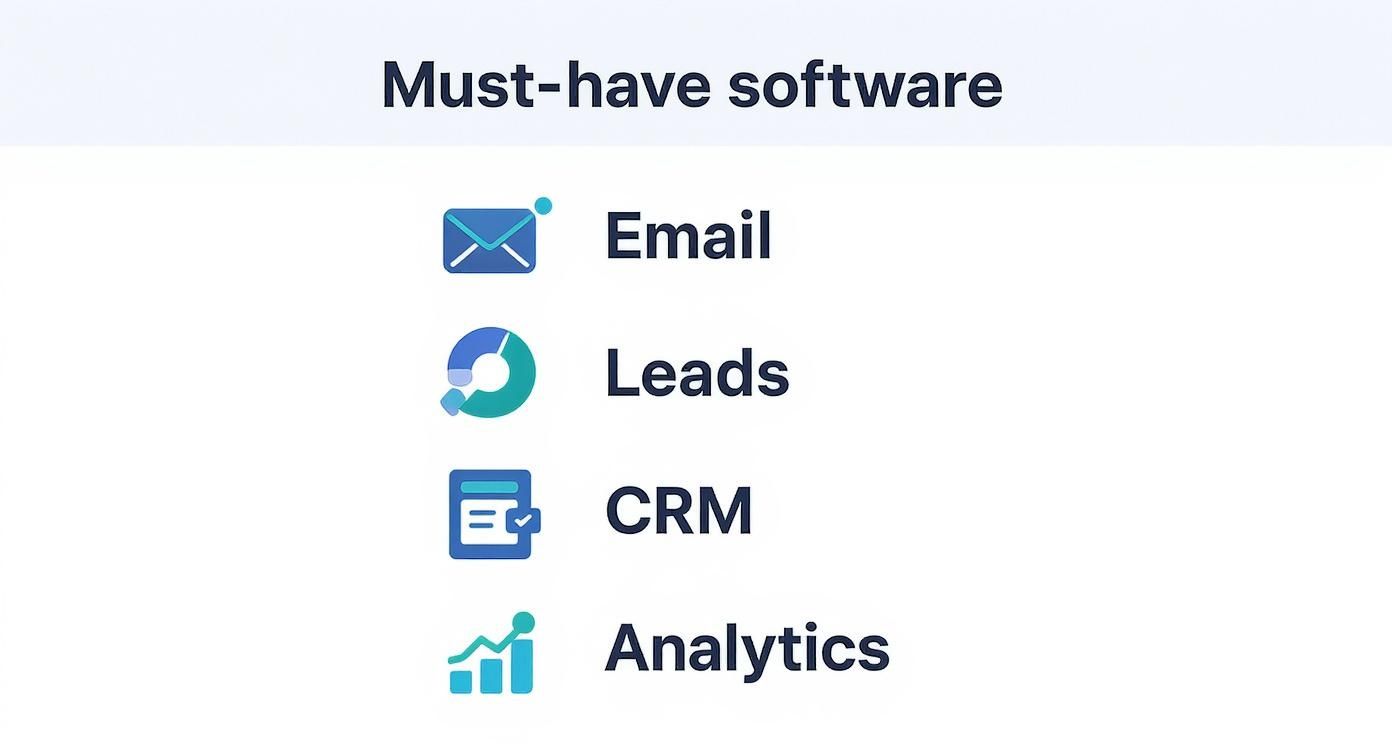
This really drives the point home: powerful email tools, lead capture forms, a simple CRM, and clear analytics are the bedrock of any solid automation strategy.
By starting with your goals and zeroing in on these essentials, you can pick the right software with confidence. For a detailed breakdown of different platforms, a good marketing automation tools comparison guide can be a huge help. And to see how these tools fit into your bigger picture, check out our guide to marketing workflow software at https://viewprinter.tech/blog/articles/marketing-workflow-software.
Measuring Your Automation ROI
Putting money into marketing automation software is a big decision for any small business. So, how do you actually know if it's paying off?
The good news is you don't need a finance degree to figure it out. Measuring your return on investment (ROI) is all about connecting your automated marketing efforts to real, tangible business growth.
Forget about vanity metrics like social media likes or even email open rates. While they're nice to look at, they don't tell you the whole story. You need to focus on the numbers that actually move the needle on your bottom line. These are the metrics that prove your new software isn't just another monthly expense—it's a profit-generating machine.
Key Metrics to Track for Automation Success
To get a crystal-clear picture of your ROI, you need to track a few specific performance indicators. These metrics cut through the noise and show you exactly how your automated campaigns are performing. Here are the three most important ones to start with:
-
Lead Conversion Rate: This is the big one—the percentage of new leads that turn into paying customers. If an automated campaign brings in 100 new leads and 10 of them buy something, your conversion rate is 10%. When this number goes up, you know your automated nurturing is hitting the mark.
-
Cost Per Acquisition (CPA): This tells you exactly how much it costs to land one new customer. Just divide your total campaign cost (don't forget to include software fees) by the number of new customers you gained. A lower CPA means your automation is making every marketing dollar work harder.
-
Customer Lifetime Value (CLV): This number predicts the total amount of money a single customer is likely to spend with you over their entire relationship. Good automation boosts CLV by keeping customers engaged with personalized follow-ups, special offers, and even automated birthday messages that make them feel valued and encourage them to buy again.
Tracking the right numbers is everything. Here’s a quick breakdown of what to watch and why it matters.
Key Metrics to Track for Automation Success
| Metric | What It Measures | Why It's Important for a Small Business | | --- | --- | --- | | Lead Conversion Rate | The percentage of leads that become customers. | Shows if your automated follow-ups are effective at convincing people to buy. | | Cost Per Acquisition (CPA) | The average cost to gain one new customer. | Helps you understand if your marketing spend is efficient and profitable. | | Customer Lifetime Value (CLV) | The total projected revenue from a single customer. | Indicates how well you're retaining customers and building long-term loyalty. | | Sales Cycle Length | The average time it takes for a lead to become a customer. | Shows if automation is speeding up the journey from interest to purchase. | | Website Engagement | How visitors interact with your site (pages visited, time on page). | Reveals if your automated campaigns are driving qualified, interested traffic. |
By keeping an eye on these metrics, you can see the real-world impact of your automation platform and make smarter decisions for your business.
When you focus on concrete numbers like these, you shift from "I think this is working" to "I know this is working." You can confidently show that every dollar you put into automation is bringing back more in return, making it an easy investment to justify.
Calculating Your Return on Investment
The ROI formula itself is pretty straightforward: (Revenue from Automation - Cost of Automation) / Cost of Automation.
The results can be truly impressive. On average, organizations see a $5.44 return for every dollar spent on marketing automation. That's a 544% ROI over three years. Some studies even show that using automation for lead nurturing can increase qualified leads by a massive 451%. You can dig deeper into the financial impact of marketing automation and see the potential for yourself.
When you get into the habit of calculating these figures, you create a powerful feedback loop. You'll quickly see which automated workflows are knocking it out of the park, allowing you to double down on what works and ensure your investment continues to fuel real, profitable growth.
Got questions about marketing automation? You're not alone. Taking the plunge with a new tool can feel like a big deal, especially when you're worried about the cost, the learning curve, or how your customers will react.
These are all fair concerns. So, let's clear the air and tackle these questions head-on. The goal here is to swap that uncertainty for confidence, so you can decide what's right for your business.
Is This Too Expensive for My Budget?
This is usually the first question on every small business owner's mind. The good news? The days of giant, enterprise-only price tags are over. The market is now full of powerful, affordable tools built specifically for businesses like yours.
Many of the best platforms have free or low-cost starter plans. And these aren't just flimsy demos—they often pack in serious features, letting you automate things like email welcome sequences and lead capture right away. You can start small, see real results, and then upgrade your plan as your business grows. The trick is finding a tool with predictable pricing that scales with you, not ahead of you.
Think of it less as a cost and more as an investment in your own efficiency. The time you get back from not doing repetitive tasks and the sales you lock in with automated follow-ups can pay for the software many times over.
Will Automation Feel Impersonal to My Customers?
The fear of sounding like a robot is real, especially for businesses that have built their reputation on a personal touch. But here's the thing: modern marketing automation is designed to make your communication more personal, not less.
The magic is in using data to make your messages incredibly relevant. Instead of blasting everyone with the same generic email, automation lets you send the right message to the right person at the right time, based on what they actually do.
- Did a customer just buy a specific product? You can automatically send them a follow-up with helpful tips for getting the most out of it.
- Someone visited your pricing page but didn't buy? A gentle, automated email can check in to answer common questions they might have.
- Is a customer's birthday coming up? An automated greeting with a special discount feels thoughtful, not robotic.
When you use it right, automation makes sure no one falls through the cracks. It creates a consistently helpful experience that would be impossible to keep up with manually, making every single customer feel seen.
How Long Until I See Results?
While you won't triple your sales overnight, you can see real results a lot faster than you might think. The secret is to start with a few simple, high-impact workflows instead of trying to automate your entire business from day one.
Focus on a "quick win" project. Here are a couple of ideas that deliver value almost immediately:
- The Welcome Email Series: Set up a simple three-part email sequence for anyone who signs up for your list. This one workflow can start building relationships and driving sales within the first week.
- Abandoned Cart Reminders: If you run an e-commerce store, this is non-negotiable. An automated email that reminds customers about items they left behind can recover lost sales right away.
- Lead Capture and Tagging: Just setting up a form that automatically adds and tags new leads in your system cleans up your process and ensures you never miss an opportunity again.
You'll feel the time-saving benefits almost instantly. As for the money, a well-built welcome series or abandoned cart flow can show a positive ROI within the first 30 to 60 days. From there, you can build out more advanced automations, knowing your initial investment is already working for you.
Ready to stop juggling repetitive tasks and start building a smarter, more efficient business? ViewPrinter provides all the tools you need to create, schedule, and automate your social media content, turning prospects into loyal customers while you focus on what you do best. Explore our platform today and see how easy it is to put your growth on autopilot.