Write a Script for Advertisement That Sells
Learn to write a script for advertisement that drives results. Our guide covers proven strategies for creating compelling ad scripts that convert.
A killer script for advertisement isn’t just about clever lines and cool visuals. It's built on a rock-solid strategy. The ads that actually work—the ones that stick with you—know their precise goal and understand their audience's deepest motivations before a single word is ever written.
Getting this foundation right is the secret to creating a message that genuinely connects.
Build Your Strategy Before You Write a Word

It’s tempting to jump right into writing, but that’s a rookie mistake. A powerful script starts with clarity, not just raw creativity. Before you even think about scenes or slogans, you need to nail down the one specific action you want your audience to take.
Is the goal to drive immediate online sales? Generate qualified leads for your sales team? Or maybe it's to build long-term brand awareness? Trying to do everything at once just muddies the water and leaves your audience confused.
Once you’ve got your objective locked in, it's time to dig deeper than basic demographics. You have to understand who you're talking to on a human level. This means creating a detailed audience persona and mapping out their daily frustrations, their quiet aspirations, and the problems they're trying to solve.
Define Your Core Objective
What is the one, single thing your ad absolutely must achieve? Be ruthless. Pick one and stick with it.
- Driving Sales: Your script needs to be direct. It should highlight a clear problem, present your product as the immediate solution, and end with an urgent call to action. Think "Shop Now" or "Get 50% Off Today."
- Building Awareness: Here, the script can be more story-driven. The goal isn't an instant click but an emotional connection that makes your brand memorable long after the ad is over.
- Generating Leads: The focus shifts to offering value in exchange for contact information. Your script will likely tease a free guide, a helpful webinar, or an exclusive consultation.
This one decision will shape the entire tone, structure, and language of your script. It's the North Star for every creative choice you make.
Understand Your Audience Deeply
Knowing your audience isn’t about age ranges and locations; it’s about understanding their internal world. What keeps them up at night? What problem does your product solve that they might not even know how to put into words?
Answering these questions is how you write copy that truly resonates. If you’re struggling to get started, our guide on how to identify your target audience provides a great framework to follow.
A great ad script doesn't just sell a product; it sells a solution to a real, human problem. By focusing on the customer's world first, you ensure every line of your script feels authentic and necessary.
The modern ad landscape is incredibly crowded. With global ad spending projected to blow past $1.03 trillion and consumers seeing thousands of ads every day, a generic message is basically invisible.
To cut through that noise, it's essential to understand how to boost creativity and craft a message that is both sharp and unforgettable. Your script has to work harder than ever to earn even a few seconds of attention.
Before we dive into the nuts and bolts of writing, let's quickly summarize the core components that form the backbone of any effective script.
Core Script Elements and Their Purpose
| Component | Purpose | Example Application | | :--- | :--- | :--- | | The Hook | Grab attention in the first 3-5 seconds with a surprising question, bold statement, or relatable problem. | A skincare ad opens with, "Is your 'glow' just sweat?" | | Problem/Tension | Clearly define the pain point your audience experiences. Make them feel understood. | An ad for a meal-prep service shows a parent staring at an empty fridge at 6 PM. | | The Solution | Introduce your product or service as the clear, simple answer to the problem. | The meal-prep box arrives, revealing delicious, easy-to-make dinners. | | Call to Action (CTA) | Tell the viewer exactly what to do next. Be specific and direct. | "Click the link below to get your first box 50% off." |
Think of these elements as your strategic checklist. Nailing each one ensures your creative ideas are built on a foundation designed for results.
Structure Your Story for Maximum Impact

Every great ad tells a story. Whether it's a quick 15-second social clip or a longer spot on YouTube, the structure of that story is what makes people watch instead of skip.
Forget about cookie-cutter formulas. The best narrative frameworks are chosen specifically for your audience and the platform you're on. Think of these structures as the skeleton for your creativity—they give your message a backbone, ensuring it lands with both clarity and emotional punch.
The Problem-Agitate-Solve Framework
One of the most reliable structures in any copywriter's toolbox is the Problem-Agitate-Solve (PAS) framework. It’s a classic for a reason: it taps directly into your audience's pain points, making your solution feel less like a "nice-to-have" and more like a "must-have."
Here’s how it works:
- Problem: Kick things off with a relatable problem. This has to be an issue your target customer immediately recognizes and connects with.
- Agitate: This is where the magic happens. Don't just state the problem—pour a little salt in the wound. Show the real frustration, the emotional cost, the annoying consequences of leaving it unsolved.
- Solve: Just as the tension peaks, swoop in with your product or service as the clear, simple, and deeply satisfying solution.
Imagine an ad for a cleaning product. It opens on a stubborn wine stain (Problem). Then, it cuts to the host scrubbing furiously while their friends are laughing and having fun at a party in the next room (Agitate). Finally, one spray of the product lifts the stain instantly, and the relieved host rejoins the celebration (Solve).
The PAS framework is so effective because it mirrors a natural psychological arc. We are wired to want resolution. By building that tension and then providing the perfect release, your brand becomes the hero of the story.
Crafting a Compelling Narrative Arc
Beyond specific formulas like PAS, every ad script needs a clear beginning, middle, and end. Pacing is everything. You're creating a tiny story that has to hook the viewer, build their interest, and point them toward a clear next step.
- The Hook (The First 3 Seconds): This is your scroll-stopper. It needs to be visually arresting, ask a provocative question, or show something completely unexpected. Whatever you do, don't waste these precious seconds on a slow-fade logo. Get straight to the good stuff.
- The Middle (Building Desire): This is where you make an emotional connection. Show, don't tell. Instead of just listing features, demonstrate the feeling your product delivers—the freedom, the confidence, the relief. Many of the best brand storytelling examples focus on this emotional payoff.
- The End (The Call to Action): Don't be shy here. The ending needs to be crystal clear. Tell the viewer exactly what you want them to do next—"Shop Now," "Learn More," "Download Our Guide." Make it feel like the obvious and satisfying conclusion to the story you've just told.
By carefully structuring your narrative, you turn a simple sales pitch into a memorable experience. It’s this thoughtful approach that ensures your script for advertisement is built to do its job.
Write Dialogue That Connects and Persuades
This is where the magic happens. Your structure is the skeleton, but the dialogue? That's the soul of your ad script. The goal here is to write words that sound like they came from a real person, not something cooked up in a marketing meeting.
Authentic dialogue is a craft. It needs to mirror how your audience actually talks—their slang, their shortcuts, their rhythm. Ditch the corporate jargon and stiff, formal language. That stuff creates an instant wall between you and the viewer.
Show, Don’t Just Tell
You've heard it a million times, and it's doubly true in advertising: show, don't tell. Instead of just listing off your product's features, drop your audience into a scenario where those features solve a real, relatable problem. It makes the benefits feel tangible and hit home on an emotional level.
Let's break it down:
- Telling: "Our new vacuum has powerful suction." (Yawn.)
- Showing: A character's kid spills a whole box of cereal. They grab the vacuum, clean it up in one effortless pass, and sigh, "Well, that was easy."
See the difference? The second one never even says "powerful suction." The audience sees it in action, which is infinitely more persuasive. You're communicating value without sounding like a pushy salesperson. And when you're trying to get those natural-sounding lines down, using effective dictation software for writers can be a huge help to just speak your ideas out and capture them as they flow.
Find Your Brand's Voice
What's your brand's personality? Is it witty and a little sarcastic? Inspiring and heartfelt? Or is it more of a no-nonsense, straight-to-the-point authority? Your dialogue is how you bring that personality to life. A consistent tone isn't just nice to have; it's how you build brand recognition and trust.
Take a tech company, for example. A witty brand might have a character complain, "Finally, Wi-Fi that won't give up on you like your last three houseplants." An inspiring brand selling the exact same thing might go with, "Stay connected to the moments that matter most." Same product, completely different emotional hooks.
Every single word has a job to do. If a line doesn't push the story forward, reveal something about a character, or highlight a key benefit, it’s just taking up space. Get ruthless with your edits.
Add Layers of Sound and Emotion
A script isn't just a collection of words; it's a blueprint for a whole sensory experience. Don't forget about your secret weapons: sound design and music. They can dial up the emotion in a scene from a 2 to a 10. You can guide the production team with simple cues right in your script.
Think about adding little notes like:
- SFX:
[Sound of a satisfying 'click' as the product locks into place.] - Music:
[Upbeat, optimistic music starts to swell.] - Tone:
(Spoken with a sigh of relief)
These auditory cues are partners to your dialogue. They work together to deepen the story's impact and turn a flat script into a memorable ad that actually sticks with people. Keep your dialogue sharp, your verbs punchy, and make every element pull in the same direction.
Adapt Your Script for Every Platform
A great master script is the perfect foundation, but it's not a one-size-fits-all solution. Treating YouTube, TikTok, and Instagram as if they're the same is one of the fastest ways to waste your time and money.
Each platform has its own culture, its own viewing habits, and its own technical quirks. You have to adapt. Your brilliant, slow-burning YouTube ad will get scrolled past in a heartbeat on TikTok. And that vertical, fast-cut TikTok video? It'll feel completely jarring and out of place as a pre-roll ad before a business-focused YouTube video. The goal is to adapt your core message, not just copy-paste your script.
Tailoring Your Message for Social Feeds
The way people scroll through social media has completely changed the game for scriptwriting. Social media ads are on track to make up nearly 40% of all digital ad spend, and it's all happening on platforms where attention is the most valuable—and scarcest—resource you have.
You're not just competing with other ads. You're competing with your viewer's best friend, their favorite creator, and the latest viral dance trend.
With the average attention span now clocking in at under eight seconds, your script has to be absolutely ruthless in its efficiency. On top of that, as influencer marketing explodes, people are getting used to seeing more authentic, creator-style content. You can get a deeper dive into these trends from recent statistics on creator-driven marketing.
To grab someone's attention in a crowded feed, you need to nail these things:
- Lead with an Instant Hook. Don't waste a single frame. Your most compelling shot, your most interesting question, or your boldest statement needs to happen immediately.
- Design for Sound-Off Viewing. A massive number of people watch videos on their phones without any audio. Your script has to work visually through on-screen text, clear subtitles, and strong visual storytelling.
- Embrace the Vertical Format. You have to shoot and edit for a vertical screen (9:16 aspect ratio). It feels native to the platform and fills the entire screen on a mobile device, which makes the experience way more immersive.
Adapting for YouTube's Unique Environment
YouTube is a completely different beast. Viewers there are often in a "lean-back" mode, ready to watch longer videos. This gives you a little more breathing room with your script, but it also introduces the dreaded "Skip Ad" button.
Your number one job for a YouTube pre-roll ad is making those first five seconds so gripping that the viewer doesn't even think about skipping. How do you do that? You can start with a fascinating problem, a sudden burst of unexpected humor, or a direct promise of what they'll get if they just stick around for a few more seconds.
This infographic really breaks down the core ideas behind making any script feel authentic and powerful.
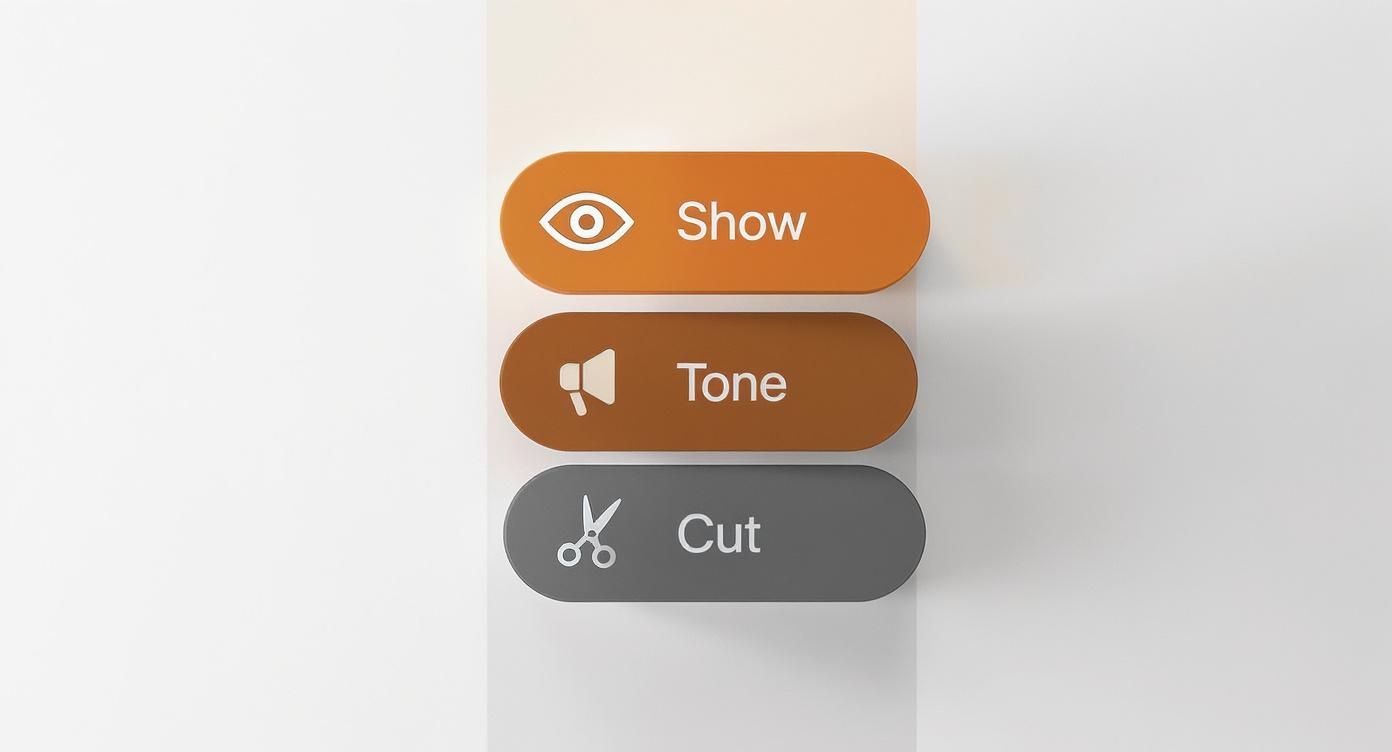
As the graphic shows, it all comes down to focusing on benefits, keeping your tone consistent, and cutting every single word that doesn't need to be there.
The real secret is to create one strong master script with a clear message, then build out platform-specific versions. That's how you make sure your ad feels right at home—and actually works—no matter where it shows up.
Thinking about where your ad will live is crucial before you finalize the script. Each platform has its own unwritten rules and audience expectations. What works on TikTok might bomb on LinkedIn, and a great YouTube ad will feel clunky as an Instagram Story.
Here’s a quick breakdown of how to think about adapting your script for the big players.
Platform Scripting Considerations
| Platform | Optimal Length | Key Scripting Focus | Format | | :--- | :--- | :--- | :--- | | TikTok | 15-30 seconds | Instant hook, trend-aware, authentic creator feel, strong call-to-action (CTA) | Vertical (9:16) | | Instagram Reels/Stories | 15-60 seconds | Visually striking, fast-paced, interactive elements (polls, stickers), seamless story flow | Vertical (9:16) | | YouTube (Pre-Roll) | 15-30 seconds | Hook in first 5 seconds to beat the "skip" button, problem/solution focused | Horizontal (16:9) | | Facebook/Instagram Feed | 30-90 seconds | Strong visuals for sound-off viewing, clear value proposition, emotional connection | Square (1:1) or Vertical (4:5) | | LinkedIn | 30-90 seconds | Professional tone, data-driven, educational, clear business value | Horizontal (16:9) or Square (1:1) |
This isn't about creating five totally different ads. It's about taking your core idea and tweaking the hook, pacing, and call-to-action to feel native to each environment. A little adaptation goes a long way.
Refine Your Script from Good to Great
Getting that first draft down is a huge milestone, but let’s be honest—the real work starts now. A good first draft has all the right pieces on the board, but a great script is polished until every word, pause, and sound cue is pulling its weight. This is the part of the process that separates ads people skip from ads that actually work.
The first thing you should do is surprisingly simple: read your script out loud. It’s the fastest way to catch clunky phrasing, dialogue that sounds like it was written by a robot, or sentences that just ramble on too long. If you stumble over a line, you can bet your audience will feel it, too.
Conduct a Table Read for Honest Feedback
Before you get anywhere near a camera or a microphone, gather a few people for a table read. This isn’t a performance. It's about getting fresh ears on your words. Just assign roles and have everyone read through the script as naturally as they can.
This simple step is invaluable. Here’s why:
- It flags awkward dialogue instantly. You'll immediately hear which lines sound like corporate jargon instead of something a real person would say.
- It tests the pacing and flow. Does the story drag in the middle? Does the beginning feel rushed? A table read makes these timing issues painfully obvious.
- It uncovers confusion. If someone reading a part asks, "Wait, what am I trying to say here?" that's a massive red flag. It means your message isn't clear enough for your audience, either.
Getting this kind of raw, unfiltered feedback early on will save you a ton of time and money later. It forces you to see the script from an outsider's perspective, helping you spot weaknesses you’ve probably gone blind to.
The goal of a table read isn't to get pats on the back; it's to find the problems. Encourage your team to be critical. Ask them straight up, "What part bored you?" or "Where did you get lost?" That kind of direct feedback is pure gold.
Use a Self-Editing Checklist
After you’ve collected some feedback, it’s time to put on your editor hat and get ruthless. Your job is to trim the fat and strengthen every single element. If you want to see how this looks in practice, check out a well-polished advertising script example to see how the pros do it.
Here’s a quick checklist to guide your edits:
- Does Every Line Serve a Purpose? If a line doesn't move the story forward, define the problem, or explain the solution, cut it. No mercy.
- Is the Hook Instantaneous? Those first 3 seconds are everything. Does your opening immediately grab attention and make someone want to know what happens next?
- Is the Call to Action Crystal Clear? There should be zero doubt about what you want the viewer to do. Is it specific, easy, and compelling?
- Have You Removed All the Jargon? Hunt down any industry-specific terms or corporate-speak and replace them with simple, everyday words your audience actually uses.
- Is the Brand Voice Consistent? Read the dialogue one last time. Does it sound like your brand? Is the tone right for the platform and the people you’re trying to reach?
This refinement process is what turns a functional script into a persuasive one. By reading it aloud, getting honest feedback, and editing with a critical eye, you’ll ensure your final script for advertisement is sharp, clear, and ready to get results.
Got Questions About Ad Scriptwriting? Let's Clear Them Up.
Even seasoned pros run into the same old hurdles when writing ad scripts. If you're wrestling with a few of these common questions, you're in good company. Let's get them sorted so you can move from a rough idea to a polished script with confidence.
How Long Should My Ad Script Actually Be?
There’s no magic number here. The right length is whatever the platform demands.
For a platform like TikTok or Instagram, you have to be brutally efficient. We're talking 15-30 seconds, which works out to about 40-75 words. On YouTube, you might have a bit more breathing room for a pre-roll ad, maybe 30-60 seconds (75-150 words), but you still have to earn that attention past the five-second skip button.
The golden rule? Be as long as you need to be to land one clear message, but as short as humanly possible. A killer 15-second spot will always beat a rambling 60-second one because it respects the viewer's time.
What's the Single Most Important Part of an Ad Script?
The first 3-5 seconds. No contest.
We live in a world of skippable ads and endless feeds. Your opening is your one and only shot to stop the scroll.
If that hook doesn't immediately grab someone with a relatable problem, a shocking visual, or a question they need answered, the rest of your script might as well not exist. Nobody will stick around to hear it. A strong hook is what buys you the right to deliver your message.
How Can I Make My Script More Emotional?
Emotion comes from human stories, not product features. You have to connect with the real-world hopes, fears, and frustrations of your audience.
Instead of saying your software saves time, show what that feels like. Show someone packing up and leaving work early to catch their kid's soccer game, a tangible, emotional payoff. Use sensory details and write dialogue that sounds like something a real person would actually say. And don't forget sound—music and sound design are massive shortcuts to emotion, so make sure to note them in your script.
What Are the Classic Scriptwriting Mistakes I Should Avoid?
A few common pitfalls can sink an otherwise great idea. If you can sidestep these, you’re already ahead of the game.
- Trying to say everything at once. This is the number one script-killer. Focus on one powerful idea. One. That's it.
- Using corporate jargon or "marketing-speak." Write like a human. If your audience doesn't talk that way, you shouldn't either. Stiff, unnatural language is an instant turn-off.
- A weak or confusing call to action. Don't be vague. Tell people exactly what you want them to do next, and make it sound easy and obvious.
- Forgetting to read it out loud. This is so simple, but so many people skip it. If the words feel awkward in your own mouth, they’ll sound ten times worse on screen. Read it aloud, and if it trips you up, rewrite it.
Ready to create viral video ads without the guesswork? ViewPrinter gives you the AI-powered tools to generate, edit, and schedule high-converting content in minutes. Start building your next campaign today!