Crafting a Script for Advertising That Sells
Learn to write a script for advertising that captures attention and drives action. This guide offers expert tips on hooks, storytelling, and conversion.
A great script for advertising isn't just words on a page; it's the blueprint for persuasion. It's the story that turns a brand's message into something that grabs attention and, more importantly, gets people to act. This is the narrative that guides everything from a 15-second social media ad to a full-blown TV commercial, making every single second count.
The Foundation Of A High-Converting Ad Script
Before you even think about writing, you need to get the architecture right. Today's audiences are smart—they can smell a sales pitch a mile away. The secret isn't just about what you say, but how you structure it to create an emotional connection.
A powerful script starts with knowing exactly who you're talking to. If you haven't nailed down your ideal customer, your message is going to disappear into the noise. To get a script to actually convert, you have to speak directly to the problems and desires of your audience. If you need a refresher, our guide on how to identify your target audience is a great place to start.
The Four Pillars Of An Effective Script
No matter how long or short your ad is, every great script is built on four core components. Think of these as the essential building blocks for getting someone from "scrolling" to "buying."
- The Hook: Those first 3-5 seconds are everything. This is where you have to stop the scroll and spark instant curiosity.
- The Problem: Hit on a pain point that makes your audience think, "Wow, they get me." It has to be relatable and real.
- The Solution: Here's where you bring in your product or service as the hero—the clear, simple answer to the problem you just laid out.
- The Action: End with a crystal-clear Call-to-Action (CTA). Tell them exactly what you want them to do next.
This flow creates a natural journey, taking the viewer from being intrigued to feeling understood, and finally, to taking a specific action.
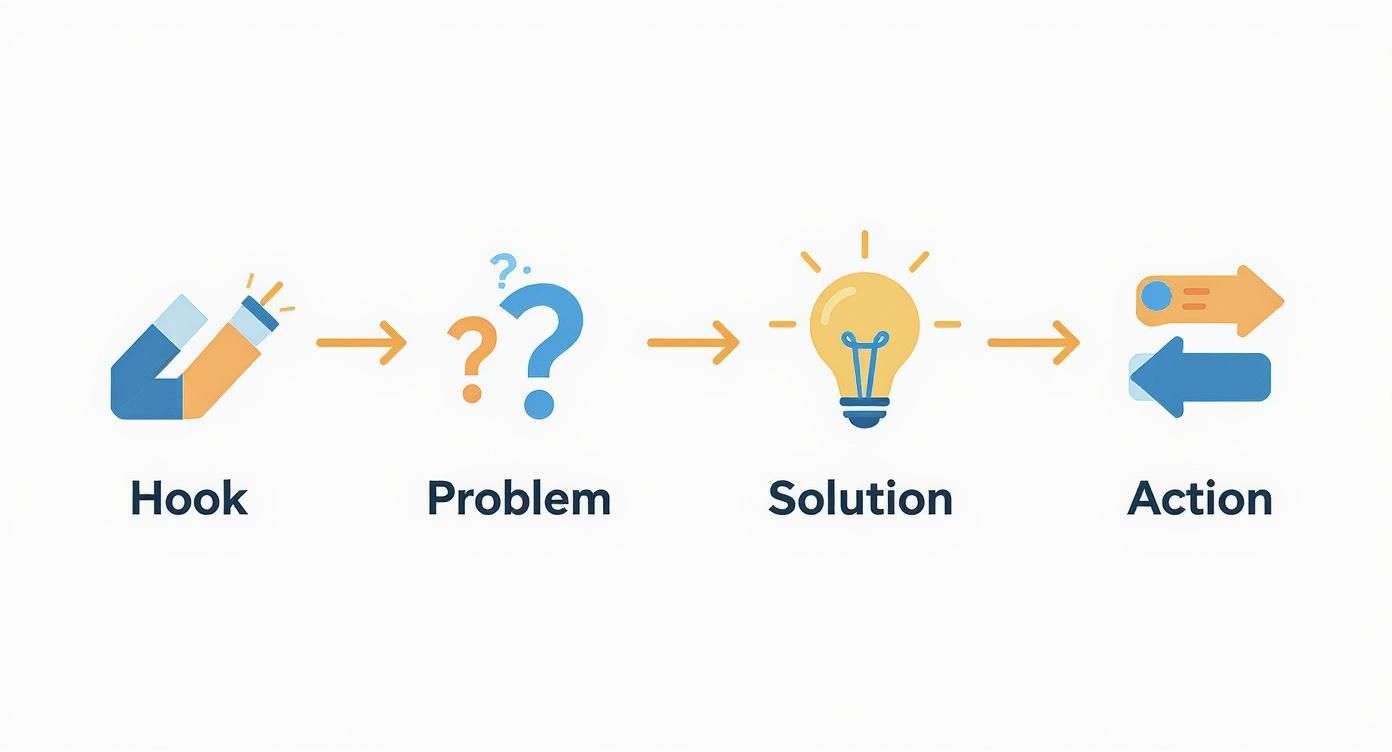
When you follow this sequence, your CTA doesn't feel like a pushy sales pitch. It feels like the logical next step for the viewer.
The way we write scripts has completely changed with the explosion of digital platforms. By 2025, digital advertising is expected to hit $798.7 billion, making up about 73% of the entire global ad market. This massive shift means we need scripts that are built for short attention spans and people watching on their phones.
To help you visualize this structure, here's a quick breakdown of how these pieces fit together in a modern ad script.
Core Components of a Modern Ad Script
| Component | Purpose | Example Snippet | | :--- | :--- | :--- | | Hook | Grab attention in the first 3 seconds. | "Stop wasting hours manually formatting spreadsheets." | | Problem | Agitate a relatable pain point. | "You're stuck doing tedious data entry instead of growing your business." | | Solution | Introduce your product as the hero. | "Our new software automates it all in a single click." | | Action (CTA) | Tell the viewer what to do next. | "Click the link below to start your free trial now!" |
Think of these components as your essential toolkit. Every successful script you write will contain these four elements, regardless of the platform.
A great script doesn't just sell a product; it sells a feeling. It resolves tension, offers hope, or creates excitement, turning a passive viewer into an active customer.
To really get this right, it helps to see different strategies to write a script for ads that actually converts. Once you master this foundation, you'll be on your way to creating ads that don't just get views, but actually deliver results.
Crafting a Hook That Stops the Scroll
You’ve got less than three seconds. That’s it. That’s the entire window you have to stop someone from scrolling past your ad. In that tiny moment, your script's hook has to be so good it physically stops their thumb mid-swipe.
This isn’t just some fancy intro—it's the single most important part of your ad. A weak hook guarantees the rest of your brilliant script, your killer offer, and your beautiful creative will never even be seen.
A great hook, on the other hand, creates an instant open loop. It sparks curiosity, hits a nerve, or feels so relatable that the viewer has to stick around to see what happens next. It breaks the pattern of their mindless scroll with a jolt.
Techniques for an Irresistible Opening
Forget starting with your brand name or a generic greeting. The best hooks dive straight into the viewer's world. They challenge a common belief, poke at a hidden frustration, or ask a question the viewer is already thinking. It makes them feel seen.
Think about the difference. "Introducing our new marketing tool" is just noise. But "You're probably wasting money on ads..." speaks directly to a deep-seated fear. That’s what you’re aiming for—an immediate emotional reaction.
Here are a few ways to pull it off:
- Ask a piercing question: "Is your social media engagement totally flatlining?" This forces an immediate self-assessment and makes them want the answer.
- Make a bold, contrarian statement: "Most of the marketing advice you see online is completely wrong." It’s provocative and instantly grabs attention.
- Show, don't tell: Kick things off with a visually stunning clip—a deeply satisfying "before and after" shot or a quick, unexpected action that leaves them wondering what just happened.
A great hook doesn’t ask for attention; it commands it. It bypasses the logical brain and taps right into raw curiosity, making the viewer think, "Okay, I need to see where this is going."
Finding and Testing Your Perfect Hook
Your first idea is rarely your best one. You need to brainstorm. Seriously, sit down and write out at least 10 different opening lines or visual concepts.
Read them out loud. Which one sounds the most interesting? Which one would make you stop scrolling?
Once you have a few solid contenders, the only way to find a winner is to test. Run A/B tests on your ads, using the exact same creative but swapping out just the hook. Let the data tell you what your audience actually responds to. The view-through rate will give you a clear answer.
If you’re stuck, a great way to get the ideas flowing is to see what’s already working. You can find a ton of effective social media hook examples to riff on for your own campaigns. The perfect hook is out there—you just have to be willing to experiment until you find it.
Connecting the Problem to Your Solution

So, you’ve hooked them. Great. But the clock is ticking. You've got their attention, and now you have to make them feel like you get them. This is where your script for advertising needs to evolve from a simple attention-grabber into a story they can see themselves in.
Your job is to build a solid bridge between the problem you poked at in your hook and the sweet relief your product provides. Don't just rattle off a list of features. You need to tell a story where their biggest frustration is the villain, and your solution is the hero swooping in to save the day. That emotional connection is what turns a "nice-to-have" product into a "need-to-have" one.
Frame the Conflict with Authenticity
Before you can be the hero, you have to make the villain feel real. This means you have to go deeper than generic pain points and tap into the specific, nitty-gritty frustrations your audience deals with every single day. Your script has to be a mirror, reflecting their reality right back at them.
For instance, "Managing social media is hard" is weak. It's forgettable. Instead, try something like: "It's 10 PM, you're staring at a blank content calendar, and you have absolutely no idea what you're going to post tomorrow." See the difference? That detail paints a picture. It feels real.
To get there, focus on the consequences of the problem:
- Wasted time: Show them the hours circling the drain on things that don't work.
- Lost opportunity: Point out the sales, growth, or connections they're missing.
- Emotional frustration: Dig into the actual stress, anxiety, or burnout the problem causes.
When you nail the real-world impact, the need for a solution suddenly feels urgent. It feels personal.
The best ad scripts don’t invent a problem. They just find the words for a problem the customer already feels but couldn't quite describe. You're just holding up the mirror.
Introduce Your Solution as the Turning Point
Okay, you've set the stage and made the conflict clear. Now it's time to bring in the hero of the story—your product. This transition needs to be smooth, like a natural plot twist that makes perfect sense. The second your solution appears, it should feel like a shift from struggle to empowerment.
Think of it as the "aha!" moment for your viewer. Your script should frame your product as more than just a tool; it's the key that finally unlocks a better way. It’s the turning point where your customer finally gets the upper hand on their problem.
Let's say you're selling comfy work-from-home clothes. The story could shift like this:
- Problem: "Another Zoom call stuck in a stiff, itchy shirt. You're just counting the minutes until you can rip it off."
- Solution Intro: "But what if you could look sharp for the camera and feel like you're still in your pajamas? Meet our new performance-stretch blazer."
That simple pivot instantly connects the pain you just described to a clear, desirable solution. It’s not just a product anymore; it's the direct answer to their frustration. That’s how you write a script for advertising that’s not just relatable but incredibly persuasive.
Writing Dialogue And Calls To Action That Convert

This is where the rubber meets the road. The words your characters speak are your direct line to the audience, and if they sound robotic or full of corporate jargon, you’ve already lost.
Forget the boardroom buzzwords. Your script for advertising needs to sound like a real conversation. A great way to test this is to read every single line out loud. Does it feel clunky? Awkward? Like something no human would ever say? If so, rewrite it until it flows.
Simple, clear language will beat complex vocabulary every single time. This is more critical than ever, especially as the digital ad world gets more crowded. In fact, by 2024, digital channels grabbed a massive 72.7% of global ad dollars, pushing spending over $790 billion. That flood of content killed off long, rambling scripts and rewarded short, punchy dialogue that works on a tiny screen. You can explore more on global advertising trends to see just how much has changed.
Making Your Call To Action Impossible To Ignore
Once you've made that connection, you have to tell your audience what to do next. This is your Call to Action (CTA), and it might be the most important part of the entire script. A lazy, generic CTA like "Learn More" is a complete waste of an opportunity.
A truly great CTA is clear, creates a sense of urgency, and screams value. It instantly answers the viewer's biggest question: "What's in it for me?"
Some of the best CTAs I've seen include a few key ingredients:
- Strong Action Verbs: Ditch passive words. Use commands like "Get," "Claim," or "Start."
- A Hint of Urgency: Phrases like "Shop Now Before It's Gone" or "Offer Ends Friday" create a little healthy FOMO.
- A Clear Value Proposition: Be specific about the benefit. "Start Your Free Trial" or "Get Your Free Quote" tells them exactly what they're getting.
Your Call to Action isn't just a button. It's the final, persuasive nudge in your story. Your goal is to make it feel like the most obvious, logical, and beneficial next step for the viewer.
Choosing The Right CTA For The Job
The perfect CTA really depends on what you're trying to achieve. Are you pushing for immediate sales? Or are you trying to generate leads for a high-ticket service? Each goal demands a different approach.
An e-commerce brand selling sneakers will probably get the best results with a direct "Shop Now." But a B2B software company might see way more success with something like "Book a Demo." The CTA has to match the audience's commitment level at that moment.
Below is a quick comparison of different CTA styles to help you decide which one fits your script.
CTA Effectiveness Comparison
| CTA Style | Psychological Trigger | Best Use Case | | :--- | :--- | :--- | | Direct & Urgent | Scarcity & FOMO | Flash sales, limited-time offers, product drops. | | Benefit-Oriented | Value & Gain | Lead generation, free trials, content downloads. | | Low-Commitment | Curiosity & Low Friction | Building brand awareness, newsletter sign-ups. | | Community-Driven | Social Proof & Belonging | Growing social media channels, event sign-ups. |
Picking the right style is all about aligning the action you want with the psychological trigger that will motivate your specific audience.
To see how all these pieces—the dialogue, the story, and the final ask—fit together in a real-world script, take a look at this detailed advertising script example. It breaks down a complete narrative from the opening hook to the final, powerful CTA.
Tailoring Your Script for Different Platforms

Here's a hard truth: a killer script for advertising is never a one-size-fits-all asset. The exact same script that crushes it on YouTube will almost certainly fall flat on TikTok.
Every platform has its own vibe, its own unwritten rules, and its own audience expectations. If you ignore these nuances, you’re basically showing up to a party in the wrong outfit—your message just won't land.
The goal isn't just to chop up your video to meet different time limits. It's about a strategic shift in tone, pacing, and visual style so your ad feels native to the platform. You want to feel like a seamless part of the user's feed, not a jarring interruption.
Mastering Platform-Specific Nuances
Think of your core script as a block of clay. For each platform, you have to reshape it to fit a specific mold. A LinkedIn ad needs to exude professionalism and deliver clear value, while an Instagram Reel has to grab attention with fast-paced, entertaining visuals.
- TikTok and Instagram Reels: Speed is everything here. You have maybe 1-2 seconds to hook someone. Scripts need to be short, punchy, and ideally built around trending audio or visual formats.
- YouTube: You get a little more breathing room on YouTube. It’s a space where you can actually tell a story, especially with skippable in-stream ads where the first five seconds are your audition to earn the viewer's attention.
- Facebook and Instagram Feed: These ads can be a bit longer and more story-focused than Reels. A direct-to-camera, conversational style works wonders, often paired with bold on-screen text for silent viewers. If you really want to dial this in, it's worth learning how to optimize your Facebook ads for better ROI.
- LinkedIn: Your audience here is in a business mindset, period. Your script has to be professional, zeroed in on industry pain points, and backed by data or a clear ROI. Forget the trendy dances; think expert insights.
The best platform adaptations are completely invisible. The viewer shouldn't think, "This is an ad." They should think, "This is great content," and only then realize it’s selling something.
Adjusting for a Global Audience
Don't forget to look beyond your own backyard. Your script needs to account for regional and cultural context, especially with the global ad market exploding.
The Asia-Pacific region alone is projected to see ad spend grow by 6.0%, hitting an incredible $361.5 billion in 2025. Markets like India are leading the charge in digital ad growth with a 20.2% increase. This means that understanding local humor, cultural references, and values isn’t just a nice-to-have—it's essential for your script to actually connect and convert.
Don't Forget Audio-Only Formats
So what happens when there are no visuals at all? Podcast ads and streaming audio spots are a completely different beast.
Your script has to paint a picture using only words, sound effects, and music. The dialogue must be crystal clear and incredibly engaging. And your call-to-action has to be simple enough for someone to remember while they're driving or jogging—think "search for our brand on Google" or "use code PODCAST10 at checkout."
Master this, and you can capture an audience's full attention, even when their eyes are a million miles away.
Got Questions About Writing Ad Scripts?
Even the best scriptwriters hit a wall now and then. Getting your ad script from a good idea to a finished product always brings up a few questions. Let's tackle some of the most common ones I hear from marketers and founders.
What’s the Perfect Length for a Video Ad Script?
There's no magic number here. The "right" length is whatever works for the platform you're on and what you're trying to achieve. It’s all about meeting the audience's expectations for that specific channel.
A solid rule of thumb is to aim for about 150 words per minute of video.
- TikTok or Instagram Reels? You're looking at a 15-30 second video. Your script needs to be lightning-fast and hit hard from the first word.
- YouTube skippable ads? Those first 5 seconds are everything. You have a tiny window to convince someone not to hit "Skip Ad." Make it count.
- Facebook feed videos? You have a little more breathing room, maybe 30-90 seconds. This is where you can weave in a bit more of a story.
Whatever you do, keep it concise. Deliver your value and get out. Never add fluff just to stretch the runtime.
How Can I Make My Script Sound Less… Salesy?
Simple: write like you talk. Use everyday language. Throw in contractions like "you're" and "it's."
Here's the best trick in the book: read every single line of your script out loud. Does it feel clunky or weird coming out of your mouth? If so, it'll sound ten times worse on camera. Rewrite it until it flows naturally.
Focus on telling a relatable story. Your ad should be about a real problem your audience has, with your product positioned as the obvious, helpful fix. When you lead with a genuine narrative, it feels less like a hard sell and more like good advice.
The second your script starts sounding like an ad, you've already lost. Aim for a conversation, not a pitch. If you focus on empathy and connection, the sale will take care of itself.
What’s the Best Way to Test My Ad Script?
Stop guessing and start A/B testing. It's the only real way to know what works. The data doesn't lie, so let it make the final call for you.
Create at least two different versions of your script to test against each other. You can switch up a few key things:
- The Hook: Pit a question against a bold, declarative statement.
- The Angle: Frame the problem from an emotional standpoint in one version, and a logical one in the other.
- The Call-to-Action: Test a direct CTA like "Shop Now" against something softer, like "Learn How."
Run these different scripts to similar audiences and watch your metrics like a hawk. Pay close attention to your view-through rate (VTR), click-through rate (CTR), and, of course, conversions.
If you want some quick feedback before spending a dime, just do a "table read" with a few coworkers. It's a low-effort way to check for clarity and see if your message is landing.
Ready to stop guessing and start creating viral content? ViewPrinter gives you the AI-powered tools to write compelling scripts, generate stunning visuals, and schedule your posts—all in one place. Start creating high-converting ads today.