
TikTok Algorithm Explained A Proven Guide to Going Viral
TikTok algorithm explained: Unlock the secrets of the For You Page. Learn the key ranking signals and proven strategies to drive growth and go viral.
Think of the TikTok algorithm as a super-smart recommendation engine. Its one and only job is to serve you an endless, hyper-personalized stream of videos on your "For You" page that it thinks you'll love.
It's like a personal DJ that’s constantly learning your vibe. Every video you watch all the way through, like, share, or even skip in the first second is a clue. The algorithm takes all these little actions, builds a unique profile of what you're into, and then tries to predict what you'll want to see next.
How the TikTok Algorithm Works: a Simple Breakdown
So, how does it actually do that? It helps to stop thinking of it as some single, mysterious force and start seeing it as a system that weighs different pieces of information to make a decision. The ultimate goal is simple: keep you on the app as long as possible. And the best way to do that is by showing you stuff it’s pretty sure you’ll find entertaining or useful.
This whole learning process is fueled by what we call "signals." These are just data points—clues—that tell the algorithm about your preferences. While the exact formula is a closely guarded secret at ByteDance, TikTok has been surprisingly open about the main types of signals it uses.
The Core Signals Fueling Your Feed
The algorithm’s decisions aren't random. It’s a calculated system that’s constantly analyzing inputs and prioritizing some over others. These inputs fall into three main buckets, and knowing them is the first step to creating content that the algorithm actually wants to push out.
- User Interactions: This is the big one. It's all about how you, the user, behave. The algorithm tracks which videos you watch to the end, which ones you rewatch, who you follow, and what you share, comment on, and like. It even pays close attention to the videos you swipe away from immediately or mark as "Not Interested."
- Video Information: These are the details embedded in the content itself. The algorithm is smart enough to "read" captions, identify the sounds or music used, and understand the context of hashtags and effects. This helps it categorize a video and figure out what it's about.
- Device and Account Settings: These are less impactful but still provide important initial context. Things like your preferred language, your country setting, and the type of device you're using help TikTok serve you relevant, local content right from the start, especially when your account is new.
To get a clearer picture, let's break down the main signals the algorithm is constantly watching.
Primary Inputs for the TikTok Algorithm
The table below summarizes the core data points TikTok's recommendation system analyzes to personalize the For You feed for each user.
| Signal Category | Examples of User Input | Impact on Your Feed | | :--- | :--- | :--- | | User Interactions | Watching a video to the end, rewatching, liking, sharing, commenting, following an account, skipping a video. | High Impact. These are direct indicators of interest (or lack thereof) and heavily influence future recommendations. | | Video Information | Captions, hashtags, sounds/music, visual effects, and video topics (e.g., "baking," "skincare"). | Medium Impact. Helps the algorithm categorize your content and show it to users interested in those topics. | | Account/Device Settings | Language preferences, country setting, device type (iOS/Android). | Low Impact. Mainly used for initial setup and localization, but has less influence over time. |
Ultimately, these signals work together to create a feed that feels uniquely yours.
The system is designed to respond to your evolving interests. If you suddenly start engaging with cooking videos after weeks of watching only car content, your For You page will quickly adapt, proving just how dynamic the learning process is.
Every time a creator or brand posts a video, they're essentially talking to this algorithm. By optimizing for the signals that matter most—especially strong user interactions like watch time and completion rate—you’re giving the system compelling proof that your content is valuable and deserves to be seen by more people. This is the foundation for every single growth strategy on the platform.
The Ranking Signals That Fuel Virality
So, how do you get the algorithm to work for you? You have to think like it does. For every single video, the algorithm is basically asking one simple question: "Is this giving the user a good experience?" And it finds the answer by looking at a whole hierarchy of signals.
The thing is, not all signals are created equal. Some are just a polite nod, while others are a full-blown standing ovation. A simple ‘like’ is a pretty weak signal—it’s passive, takes no effort. The real magic happens when a user takes an action that shows they're genuinely invested. That's the secret sauce that gets a video pushed from a small test group to millions of For You pages.
At the end of the day, TikTok wants to keep people on the app for as long as possible. So, it heavily favors signals that prove a user is hooked. If you can master this hierarchy, you can create content that doesn't just get seen, but gets promoted.
The Ultimate Signals: Watch Time and Completion Rate
Let's cut right to the chase. The undisputed champions of TikTok are watch time and completion rate. These two metrics scream to the algorithm that your video was so good, someone stopped scrolling and dedicated their precious attention to it from start to finish.
Think about it: a like is a split-second tap. Watching a 30-second video all the way through is a 30-second investment. The algorithm loves that. A high completion rate is the single most powerful signal you can send that your content is hitting the mark.
This isn't new, but it's more important than ever. TikTok's AI has gotten incredibly smart, moving way beyond simple engagement. It now analyzes viewing patterns almost second-by-second to figure out what keeps people watching. Videos watched all the way through can get up to three times higher distribution. That says it all.
The algorithm sees a full watch as the ultimate compliment. It assumes that if one user found your video worth their entire attention span, a whole lot of other people just like them will feel the same way. And that's when it hits the gas on distribution.
Strong Signals: Shares, Saves, and Comments
Right behind watch time are what I call the "high-intent" signals. These take more effort than a double-tap and show a much deeper connection to your content.
- Shares: When someone shares your video, they're not just engaging—they're endorsing you. They're putting their own little stamp of approval on it for their friends to see. This is a huge vote of confidence and a powerful way to get your video in front of totally new audiences.
- Saves: A save is a signal that your content was so valuable—whether it was funny, educational, or just plain cool—that the user wants to come back to it later. This tells the algorithm you're making high-quality, "evergreen" stuff that has real staying power.
- Comments: Likes are passive, but comments are a conversation. They show your video sparked an emotion or a question strong enough to make someone stop and type. That level of active participation is pure gold.
Important Contextual Signals: Video Information
The algorithm is smart, but it can't read minds. It needs you to tell it what your video is about so it can find the right audience. It "reads" your content by scanning a few key things.
These clues help it categorize your video and match it with people who have shown interest in that topic before.
- Captions and On-Screen Text: Keywords in your caption and any text you put on the video are direct pointers to your topic.
- Hashtags: Think of these as filing labels. They help the algorithm slot your video into the right niches and trends.
- Sounds and Effects: Hopping on a trending sound or effect instantly connects your video to a much bigger conversation happening on the platform, making it way more discoverable.
Foundational Signals: Device and Account Settings
Finally, there are the basics. The algorithm uses a user's device and account settings to give your video its very first little push. These signals carry less weight than what users do, but they're critical for getting your video in front of that initial test audience.
These settings include:
- Language Preference: Simple enough—it makes sure your video is shown to people who can actually understand it.
- Country Setting: This helps localize your content, giving it a starting point within a specific country or region.
- Device Type: This is a minor factor, but it can sometimes play a small role in optimizing the viewing experience.
These foundational signals are just the starting point—the algorithm's first educated guess. From there, it's all about performance. How long people watch and whether they share or comment is what will ultimately decide if your video fizzles out or becomes a viral hit. Nailing these signals while also knowing the best posting times for TikTok is how you stack the deck in your favor.
Your Video's Journey From Post to Viral Hit
The second you hit "post" on TikTok, your video starts a high-stakes audition. It doesn't just sit on your profile waiting for followers to stumble upon it. The algorithm immediately throws it into the ring to see if it can hold its own.
Think of it like a rocket launch. Each stage needs enough fuel—positive engagement signals, in this case—to blast your content into the next, bigger orbit of viewers.
This all starts with an initial test batch. The algorithm pushes your new video to a small, handpicked group of a few hundred users. This isn't random. It’s a calculated mix of some of your followers and, more importantly, other people who have already shown they like content similar to yours. This is the first and most critical test.
The Initial Performance Audit
In this first hour, the algorithm is a ruthless judge. It’s not just looking at if people engage, but how fast and how deeply they do. It needs to see immediate, powerful signals that your video is a winner.
Here’s exactly what it’s measuring:
- Video Completion Rate: Did people watch all the way to the end? This is probably the most important signal of all.
- Rewatches: Did they immediately watch it again? A loop is a massive vote of confidence for your content.
- Early Likes and Comments: Did the likes and comments start rolling in within the first few seconds?
- Shares and Saves: Was the video good enough for someone to send to a friend or bookmark for later?
If your video smashes it with this initial test group, it gets a promotion. The algorithm then pushes it out to a much larger, more diverse audience, and the whole cycle starts over. Great performance fuels a wider reach. Bad performance? Your video’s journey pretty much ends there.
This diagram breaks down the signals that tell the algorithm whether to give your video the green light.
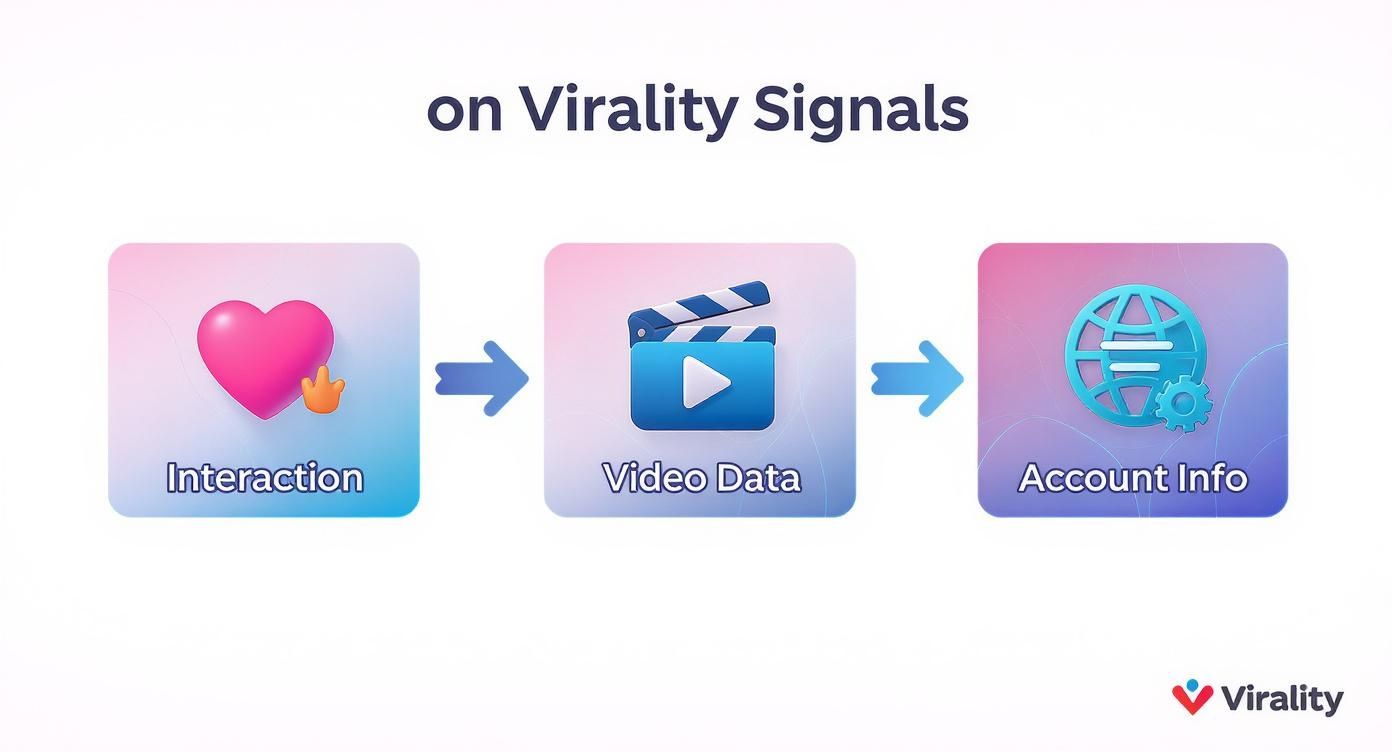
As you can see, a video's success isn't luck. It's a direct result of how well it hooks viewers and how clearly the algorithm understands what it's about.
The Phenomenon of the Delayed Explosion
But here’s where it gets interesting. A video’s journey isn't always a straight line. I’ve seen plenty of videos do absolutely nothing for days, or even weeks, and then suddenly take off. This is the "delayed explosion."
It often happens when the algorithm decides to re-test your video with a different pocket of users, or when a new trend makes your old content suddenly relevant again.
For example, a new sound might start trending that’s a perfect fit for a video you posted last month. The algorithm is always looking for these connections, and it might start feeding your old video back into For You pages, giving it a second shot at going big. This is exactly why you should never delete videos that underperform. You just never know. To make the most of this, it helps to understand the fundamentals of how to go viral on TikTok by creating content that has a longer shelf life.
A video's initial performance is a strong predictor of its potential, but it's not the final verdict. The TikTok algorithm is constantly re-evaluating content based on new user behavior and emerging platform trends.
Ultimately, this multi-stage system is what makes TikTok feel like a true meritocracy. The quality of a single video—and its raw ability to grab and hold attention—matters way more than how many followers you have. Once you get how this journey works, you can start creating content that’s designed to pass every single one of these algorithmic checkpoints.
Proven Strategies to Master the Algorithm
Knowing the theory is one thing. Actually putting it to work is what separates the accounts that feel stuck from the ones that go viral.
Think of this as your tactical playbook. These aren't just vague ideas; they're proven, testable strategies designed to give the algorithm exactly what it wants: incredible watch time and deep engagement. Let's get out of the guessing game and start engineering content that performs.
The Irresistible First Three Seconds
Forget minutes. On TikTok, you have a split second to earn a viewer's attention. That's why the hook—the very beginning of your video—is everything. A great hook stops the scroll cold and convinces someone to give you their time, which is the single most important signal you can send the algorithm.
A weak opening is a death sentence; your video will fail its initial test with that small user group. But a powerful, magnetic hook can completely change the game, boosting your completion rate and sending a clear message that this video is worth showing to millions more.
Maximize Watch Time with Smart Storytelling
Okay, you’ve hooked them. Now what? Your job is to keep them glued to the screen until the very end. The easiest way to do this is with a simple narrative arc. Even in a 10-second video, having a clear beginning, middle, and end helps hold attention.
Another killer technique is the satisfying loop. This is where the end of your video flows seamlessly back into the beginning, tricking people into watching it two or three times before they even realize it. The algorithm absolutely loves rewatches because they send total watch time through the roof.
A perfect loop is a creator's secret weapon. It tricks the viewer into watching the video multiple times before they even realize it, which can skyrocket your average watch time and give your content a significant algorithmic boost.
To get started, here are a few proven formulas for both hooking viewers and keeping them engaged. Think of these as templates you can adapt to your own niche.
TikTok Hook Formulas and Retention Tactics
| Strategy Type | Hook Example / Tactic Description | Why It Works (Psychological Trigger) | | :--- | :--- | :--- | | Problem/Solution Hook | "Stop making this one mistake when editing your videos..." | Urgency & Self-Interest: People want to avoid common pitfalls and improve their skills. | | "You're Doing It Wrong" Hook | "You've been using your air fryer all wrong..." | Curiosity & Superiority: Challenges a common belief and makes the viewer question their own methods. | | Curiosity Gap Hook | "This is the one thing that 10X'd our sales last month..." | Intrigue: Teases a valuable piece of information without giving it away immediately, forcing them to watch. | | Visual "Loop" Tactic | Video ends at the exact visual frame it started on, creating a seamless rewatch experience. | Pattern Recognition: The brain enjoys a complete, satisfying pattern, encouraging multiple views. | | Audio "Loop" Tactic | The final word or sound of the video connects perfectly to the first word or sound. | Auditory Illusion: Creates a smooth, almost hypnotic transition that can go unnoticed, driving up watch time. |
Experiment with these frameworks. Mix and match them. See which ones resonate with your audience and start incorporating the winners into your regular content strategy.
Tap into Existing Conversations
You don’t always have to reinvent the wheel. TikTok is built on trends, and plugging into what's already popular is a shortcut to getting discovered. Using trending sounds, effects, and formats is like telling the algorithm, "Hey, my video belongs over here, with this audience."
- Trending Sounds: This is a direct line to distribution. The algorithm often gives a natural boost to content using audio that's currently taking off.
- Stitch and Duet: These features are your ticket into a trending conversation. By reacting to or adding your take on a popular video, you get to piggyback on its existing momentum.
Building on trends is a great start, but true growth comes from building a loyal community. These 5 Steps to Grow Your Fan Base on TikTok can give you some great ideas for turning casual viewers into dedicated followers.
Establish a Consistent Posting Cadence
Consistency is king. Posting on a regular schedule helps the algorithm learn your niche and pinpoint your ideal audience much faster. This isn’t about burning yourself out by posting five times a day. It’s about creating a sustainable rhythm that you can stick to.
A consistent cadence does two things: it signals to the algorithm that you're a serious creator, and it trains your followers to expect content from you. This creates a stable baseline of engagement, giving every new video a stronger launchpad to pass that crucial initial test. If you're struggling to find a rhythm, our guide on how to get more views on TikTok breaks down how to optimize your schedule.
When you nail all four of these—a killer hook, smart storytelling, tapping into trends, and a steady posting rhythm—you create a powerful feedback loop. Each element builds on the last, sending all the right signals to an algorithm that's hungry to reward content that truly holds attention.
Let's bust some of the biggest myths floating around about the TikTok algorithm.
Getting bad advice can send you chasing strategies that just don't work, wasting a ton of time and energy. So, let's clear the air and get to the truth.
Myth 1: Business Accounts Get Throttled
There's a persistent rumor that switching to a Business Account will kill your reach. The theory is that TikTok wants to squeeze businesses for ad money by burying their organic posts.
This just isn't true.
The real difference comes down to features. Business Accounts get access to a commercial music library and more robust analytics, while Creator Accounts can use the full library of trending, popular sounds. Your reach isn't determined by your account type—it's all about performance. Watch time, engagement, and completion rate are what matter.
If a video from a Business Account flops, it’s almost always because it's using a less-viral commercial sound, not because the algorithm is penalizing it.
Myth 2: Shadowbanning Is a Real Thing
"Shadowban" is a term that gets thrown around every time a creator's views suddenly drop. It suggests TikTok is secretly punishing your account without telling you.
While TikTok absolutely will limit the reach of videos that break its rules, there isn't some secret "shadowban" system out to get you.
If your views suddenly tank, it's almost always one of these three things:
- Guideline Violation: Your video was flagged for something that makes it ineligible for the For You feed, like unoriginal content or low-quality production.
- It Just Flopped: Your new videos just didn't connect with their initial test audience, so the algorithm never pushed them out to a wider one. It happens.
- A Glitch in the Machine: Sometimes, it’s just a technical issue on TikTok’s side that can mess with analytics or distribution for a bit.
Instead of jumping to the "shadowban" conclusion, do a quick audit of your content against TikTok's Community Guidelines. The problem is usually right there in plain sight.
Myth 3: You Must Post 3-5 Times a Day
You've probably heard you need to post three to five times a day to get noticed. While being consistent definitely helps train the algorithm and get your audience used to seeing you, quality always wins over quantity.
One great video that hooks viewers and keeps them watching is way more powerful than five mediocre ones. Focus your energy on nailing that hook and maximizing your watch time.
And what about deleting videos that don't perform well? Don't. There's a common fear that deleting a "flop" hurts your account, but TikTok has officially confirmed this is false. Deleting old videos has no negative impact.
In fact, sometimes videos have a "delayed explosion" and blow up weeks or even months later. You're better off just leaving them up—you never know when one might catch a second wind on a new trend.
Answering Your Top Algorithm Questions
Alright, we’ve covered the core mechanics. But I know you still have those nagging "what if" questions that pop up when you're actually trying to make this work. Let's get them answered.
Think of this as the practical advice you'd get from a creator who's been in the trenches.
How Long Until the Algorithm Actually Finds My Niche?
This is a big one. You're posting consistently, but when does TikTok finally "get" you? There’s no magic number, but from what I’ve seen, it takes about 15-30 videos on the same topic for the algorithm to confidently know who to show your content to.
In those early days, the system is just throwing your videos at different groups of people to see what sticks. Your job is to make that process easier by sending it super clear signals. Stick to your theme, use relevant sounds and text, and be consistent. The faster it can categorize you, the faster it can find your people.
The algorithm learns from patterns. If you post about baking today, vintage cars tomorrow, and your cat the next day, you’re just confusing it. Pick a lane and stay in it, especially at the beginning.
Can I Reset My For You Page? It's a Mess.
Yes, and sometimes you absolutely should. If your For You page is a wasteland of content you don't care about anymore, you can give it a fresh start. TikTok actually built a feature for this.
Here’s how to do it:
- Head over to Settings and privacy.
- Tap on Content preferences.
- Choose Refresh your For You feed and just follow the instructions.
This basically tells the algorithm to forget what it thinks it knows about you. From there, you can retrain it by only engaging with the kind of videos you actually want to see.
Are Hashtags Still a Thing?
They are, but not in the way they used to be. A few years ago, you could load up on hashtags and hope for the best. Now, the algorithm cares way more about powerful signals like how long people watch your video and what they do after.
Think of hashtags as simple labels. Using 2-3 super-relevant hashtags helps the algorithm quickly understand your video's topic for that first little push. But let's be clear: a mountain of hashtags won't save a boring video. Your content has to hold attention on its own.
Ready to stop guessing and start creating content the algorithm loves? ViewPrinter provides the AI-powered tools you need to generate viral hooks, produce engaging videos, and schedule your posts for maximum impact. Streamline your entire workflow from a single platform.
Discover how to scale your content strategy at https://viewprinter.tech.