What Is Direct Response Marketing
What is direct response marketing? A practical guide on how to drive immediate, measurable results with proven strategies and real-world campaign examples.
Direct response marketing is all about one thing: getting someone to do something right now.
Forget those fuzzy, feel-good ads that just build brand awareness over time. Every single piece of a direct response campaign—from the headline to the button color—is designed to provoke a specific, measurable action. We're talking about a click, a phone call, a download, or a purchase.
The Core of Action-Oriented Marketing

Think about brand marketing—like a giant billboard or a flashy Super Bowl commercial—as planting a seed. You hope that one day, years from now, it grows into a tree of customer loyalty.
Direct response marketing, on the other hand, is like walking up to someone and asking a direct question. You expect an immediate answer. It’s built for speed, action, and most importantly, accountability.
This approach flips marketing on its head, turning it from a simple expense into a profit-generating machine. Every dollar you spend is tied directly to a result you can see and count. It's closely related to performance marketing, where you often only pay when a specific action, like a sale or lead, actually happens.
Why Immediate Results Matter
The whole point is to shrink the time between someone seeing your ad and taking action. You do this by making the path from interest to conversion as smooth and compelling as possible. Instead of just showing off a product, you present an irresistible offer with a crystal-clear call-to-action (CTA).
So, what makes a campaign "direct response"? A few key ingredients:
- A Specific Offer: This isn’t about vague brand promises. It’s a clear, tangible value proposition, like “Get 50% Off Today Only” or “Download Your Free Guide Now.”
- A Sense of Urgency: You'll often see tactics like countdown timers or "limited quantity" warnings. These are there to get people to act now instead of putting it off.
- A Clear CTA: The ad tells the audience exactly what to do next. There’s no room for guessing.
- A Targeted Audience: These messages aren’t blasted out to everyone. They’re aimed at a very specific group of people who are most likely to be interested. If you need help with this, our guide on how to identify your target audience is a great place to start.
The entire system is built around a single, powerful question: "Did they do the thing we wanted them to do?" If the answer is no, you tweak the campaign until it works. This relentless focus on optimization is what makes it so darn effective.
Let's quickly look at how this stacks up against traditional brand marketing.
Direct Response vs Brand Marketing at a Glance
| Characteristic | Direct Response Marketing | Brand Marketing | | :--- | :--- | :--- | | Primary Goal | Generate immediate action (sales, leads) | Build long-term brand recognition & loyalty | | Measurement | Highly trackable (clicks, conversions, ROI) | Harder to measure (sentiment, awareness) | | Call-to-Action | Specific and urgent ("Buy Now," "Sign Up") | Vague or non-existent ("Think of Us") | | Time Horizon | Short-term results | Long-term investment | | Audience | Highly targeted, niche segments | Broad, mass-market appeal | | Tone | Persuasive, direct, and compelling | Emotional, aspirational, and creative |
As you can see, they're two sides of the same coin, but with very different jobs. Direct response is your sales engine, while brand marketing builds the foundation.
One of the most appealing things about this strategy is its provable return on investment (ROI). For example, direct mail—a classic direct response channel—still pulls in an average ROI of 161%, smoking many digital-only channels. It just goes to show that when you directly ask for action, you get results.
The Three Pillars of a Winning Campaign
Every great direct response campaign, from a slick social media ad to a classic mailer, is built on three pillars. Think of it like a three-legged stool—kick one leg out, and the whole thing comes crashing down. Nail these three, and you've got a powerful engine for turning casual interest into immediate action.
These pillars are the Offer, the Creative, and the Call-to-Action (CTA). Each one has a specific job, but they have to work together perfectly to walk your audience from "What's this?" to "I need this now."
Let's break down what each one does.
The Offer: An Irresistible Proposition
The offer is the heart and soul of your campaign. It’s the specific deal you put on the table, and it needs to be so good that your audience feels like they'd be crazy to pass it up. This isn't just about your product; it's about the value you're giving them right now.
A killer offer creates a powerful sense of urgency and value. It immediately answers the question floating in your customer's head: "What's in it for me, and why should I care now?"
Some of the most effective offers are simple and direct:
- Discounts: "Get 50% off your first order—this week only!"
- Bonuses: "Buy one, get one free."
- Free Trials: "Try our premium features free for 30 days, no credit card required."
- Exclusive Content: "Download our free guide to unlocking viral growth."
The whole point is to make saying "yes" a no-brainer. The more irresistible your offer, the less friction there is for someone to take the next step. A boring or generic offer won't motivate anyone, even if the rest of your ad is a masterpiece.
The Creative: Grabbing and Holding Attention
While the offer gives people a reason to act, the creative is what gets them to stop and listen in the first place. This is everything your audience sees and reads: the copy, the images, the video, the design. Its job is to stop the scroll.
But good creative does more than just look pretty. It tells a story and makes an emotional connection. It shows your audience a problem they actually have and positions your offer as the perfect, obvious solution.
The creative is the bridge between your audience's problem and your offer's solution. It has to be compelling enough to get them to cross it.
Think of a video ad showing a frustrated entrepreneur drowning in content creation before revealing an automation tool that saves them hours a day. The ad's copy would then echo that pain point and point them straight to the irresistible offer.
The Call-to-Action: The Final Push
Finally, we have the Call-to-Action (CTA). This is the crystal-clear instruction that tells your audience exactly what you want them to do next. This is where so many campaigns fall flat. Ambiguity is the enemy of action.
A strong CTA is direct, concise, and leaves zero room for doubt. It uses action-oriented words. Vague phrases like "Learn More" can work sometimes, but specific commands almost always do better. Just feel the difference between these two:
- Weak CTA: "Find out about our services."
- Strong CTA: "Claim Your Free Trial Now!"
The second one feels personal and urgent. It creates a sense of ownership. The CTA is that final, essential nudge that turns a passive viewer into an active lead or customer, finishing the job that the offer and creative started.
How Direct Response Works in the Real World
Theory is one thing, but seeing direct response marketing in action is where it really clicks. This isn't some high-concept strategy locked away in a textbook. Its principles are incredibly flexible, showing up everywhere from your mailbox to your social media feed. Whether it's old-school or digital, the core formula is always the same: get a reaction.
The goal is to create a seamless, almost frictionless path from seeing an ad to taking action. A great direct response campaign doesn't feel like a pushy sales pitch. It feels like a timely solution showing up at the perfect moment.
This visual breaks down how the key elements of a winning campaign—a compelling offer, engaging creative, and a crystal-clear call-to-action—work together to drive real results.
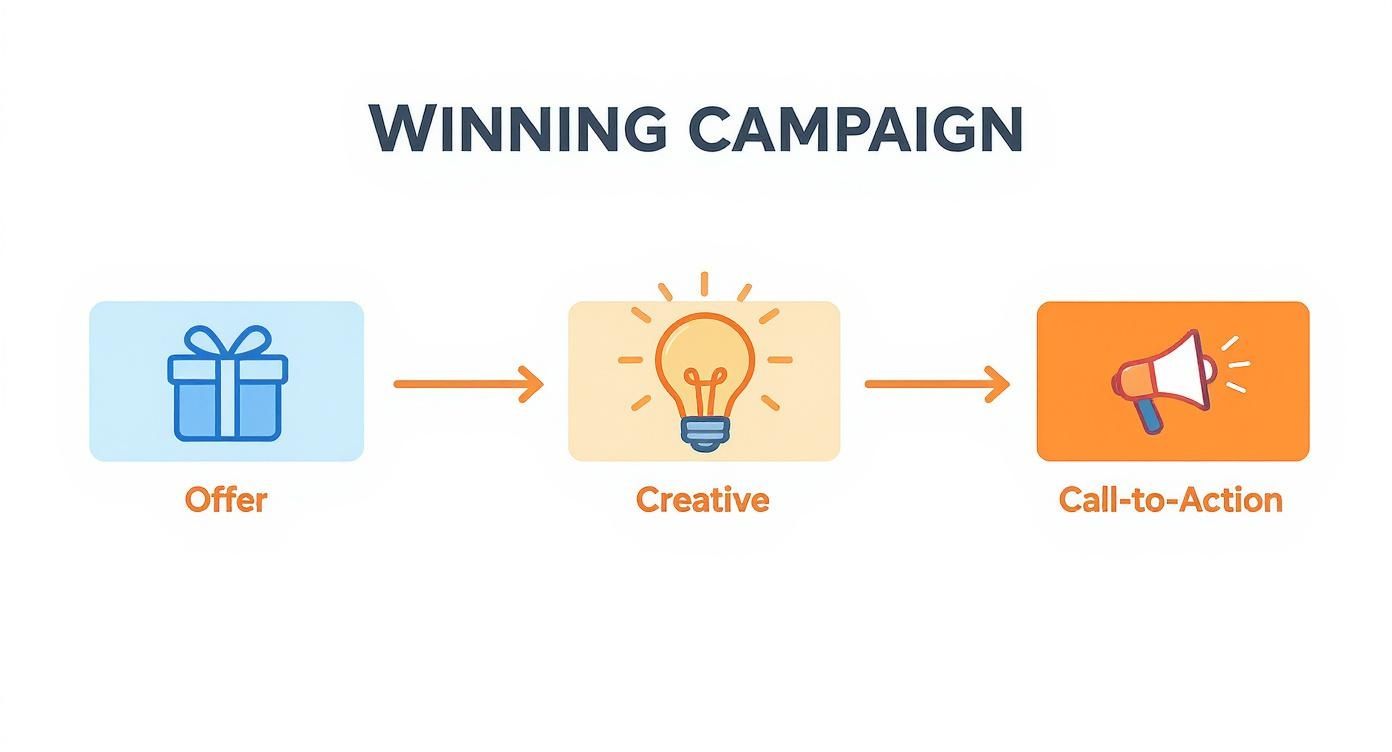
As you can see, all three have to be perfectly aligned. When they are, a person’s attention turns into measurable action.
Classic Channels Still Pack a Punch
It might feel a little old-fashioned, but direct mail is still a heavyweight champ in the direct response world. Why? Because a physical piece of mail cuts through the digital noise. It commands attention in a way an email or banner ad struggles to. Think of a postcard with a unique QR code that zaps you to a personalized landing page with a special discount.
This tangible approach gets incredible results. In fact, a whopping 85% of marketers agree that direct mail delivers the best conversion rate of any channel they use. An impressive 84% also say it gets the highest response rate, proving that a well-crafted physical offer is hard to ignore. You can dig into more direct mail stats in this detailed report from Postalytics.
Modern Digital Applications
Of course, the principles of direct response absolutely thrive online. Digital platforms give us amazing tools for targeting, testing, and tracking, making them a perfect home for this data-driven strategy.
Here are a few examples you probably see every single day:
- Social Media Ads with Instant Forms: You're scrolling Facebook and see an ad for a free ebook. You click, and a pre-filled lead form instantly pops up. It's so easy to convert because there's almost no work involved.
- Search Engine Ads with Click-to-Call: Someone frantically searches "emergency plumber near me" and sees a Google Ad with a big "Call Now" button. It’s a direct, immediate solution right at their moment of need.
- Email Campaigns with Countdown Timers: An email lands in your inbox about a flash sale. Inside, a ticking clock shows exactly how much time is left to claim that 25% discount. That urgency is powerful.
The channel may change, but the psychology never does: present a clear offer, make it irresistible with great creative, and tell the person exactly what to do next.
Each of these examples is built for instant gratification and perfect measurement. The social ad tracks form fills, the search ad counts calls, and the email campaign monitors every click and sale. Getting the message right is everything, which is why having a solid advertising script example can be a game-changer for video ads or copy. The goal is always the same: connect every dollar spent to a specific, trackable outcome.
Forget Silos: The Real Power Is in Combining Digital and Direct
In a world drowning in digital noise, the smartest direct response campaigns don't just stick to one channel. The real magic happens when you pair the tangible, can't-ignore feeling of direct mail with the sharp targeting and tracking of digital marketing. This isn't just about adding another channel; it's about creating a multiplier effect that makes your entire strategy stronger.
Think about it this way: a potential customer gets a stunning postcard in the mail. It's got a great offer and a simple QR code. When they scan it, they don't just land on your generic homepage. Instead, they hit a personalized landing page that mirrors the postcard's message, with their discount code already waiting for them at checkout.
That seamless connection is what modern marketing is all about. You’re turning a single touchpoint into a connected, cohesive customer journey.
Building a Truly Unified Customer Experience
The goal is to make every interaction feel like one continuous conversation. By linking your physical mailers to your digital efforts, you reinforce your message over and over again, making it incredibly easy for customers to say "yes." This isn't just some clever gimmick anymore; it's a proven way to boost engagement and conversions.
This approach gives you the best of both worlds:
- The Unmissable Impact of Direct Mail: A physical piece of mail cuts through the digital clutter. It demands to be seen and handled in a way an email or banner ad simply can't.
- The Sharp Tracking of Digital: The moment someone scans that QR code or types in a unique URL from your mailer, their entire journey becomes measurable. You can see exactly what's working and what isn't.
When you guide a customer from a physical mailer to a digital landing page, you’re instantly bridging the gap between offline interest and online action. The whole campaign becomes transparent, measurable, and optimizable from start to finish.
This integrated strategy also opens the door for some seriously smart follow-up. That same person who visited your landing page can now be added to a retargeting campaign on social media, seeing ads that echo the original offer and gently nudge them toward making a purchase.
Watch Your Response Rates Climb
Combining channels isn't just about creating a slick experience—it's about getting drastically better results. The data doesn't lie: integrated campaigns consistently blow single-channel efforts out of the water.
For example, campaigns that mix direct mail with digital advertising can see anywhere from a 27% to 118% lift in response rates. Some marketers have even reported an eye-popping 400% jump in effectiveness when they use print and digital together.
More specifically, 68% of marketers say combining direct mail with digital drives more website visits, and 53% see a direct increase in lead generation. You can dig into more of these powerful stats over at LettrLabs. The takeaway is crystal clear: a unified approach isn’t just a nice-to-have. It’s essential for maximizing your ROI and making your direct response marketing more powerful than ever.
How to Measure What Truly Matters
Unlike brand marketing, where results can be fuzzy and hard to pin down, the greatest strength of direct response marketing is its radical measurability. Every click, call, and sale can be tracked back to the exact ad that inspired it.
This isn’t just about collecting data for reports; it’s about getting real-time feedback to make your campaigns smarter and more profitable on the fly. You don't need a complex analytics department to get started. The goal is simple: create a clear, unbroken line from your ad spend to your revenue.
Simple Tracking Methods That Work
Getting started with tracking is way easier than you think. By assigning unique identifiers to each campaign, you can instantly see where your responses are coming from.
Here are a few classic methods that just plain work:
- Unique Promo Codes: Assign a different discount code to each ad variation. Think "PODCAST20" for a podcast ad and "FACEBOOK20" for a social ad. This tells you precisely which channel is driving sales.
- Dedicated Landing Pages: Create a specific landing page for each campaign. If a visitor lands on
yourwebsite.com/offer, you know they came from that specific campaign. Using UTM parameters in your URLs adds another powerful layer of detail. - Trackable Phone Numbers: Use different phone numbers for different ads. This is a foolproof way to measure call volume from print, radio, or even your search ad campaigns.
The core idea is simple: if you can't measure it, you can't improve it. Direct response forces you to connect every marketing action to a tangible business outcome, eliminating guesswork and wasted budget.
Key Metrics You Need to Know
Once your tracking is set up, it's time to focus on the metrics that actually impact your bottom line. Forget vanity metrics like impressions or likes. Effective direct response marketing hinges on clear performance indicators that tell you if you’re actually making money.
Here are the big three:
- Cost Per Acquisition (CPA): This is the total cost you spend to get one new customer. If you spent $100 on an ad and got two sales, your CPA is $50. Your goal is to keep this number well below your customer’s lifetime value.
- Conversion Rate: This is the percentage of people who took your desired action after seeing your ad. If 1,000 people saw your ad and 50 of them bought your product, your conversion rate is 5%.
- Return on Ad Spend (ROAS): This is the ultimate measure of profitability. It shows exactly how much revenue you generate for every dollar spent on advertising. Understanding what constitutes a good ROAS is vital for scaling your campaigns effectively.
These metrics aren't just for looking back—they're your tools for relentless optimization. By A/B testing your creative, offers, and CTAs, you can systematically lower your CPA and boost your ROAS. For a deeper dive into measuring returns, check out our complete guide on how to measure social media ROI.
Putting Direct Response into Action Today

Alright, enough theory. The real magic happens when you turn all this knowledge into actual results. It’s time to build your first direct response campaign. Don't worry, you don’t need a massive budget. A small, focused test is all it takes to get some quick wins and powerful insights.
The whole point is to start small, see what sticks, and then double down on what works. By following a simple framework, you can go from concept to launch with confidence and get a campaign out the door that starts delivering results from day one.
Your First Campaign Checklist
Ready to roll? Use this simple, four-step checklist to get your first direct response effort off the ground. Whether you’re running a social media ad, sending an email, or even trying out a direct mail piece, these fundamentals never change.
-
Define Your Target Audience: Seriously, who is this for? Get hyper-specific. "Small business owners" is way too broad. Think more like, "E-commerce entrepreneurs selling handmade goods who have clicked on our last three blog posts." A laser-focused audience means your message will actually hit home.
-
Craft an Irresistible Offer: What's the deal? Make it something they can't ignore and put a clock on it. A generic "10% off" is fine, but it’s forgettable. "Free Shipping + a Bonus Gift on all orders this weekend only" is a whole lot better. It adds real value and creates genuine urgency.
-
Write a Clear Call-to-Action (CTA): What do you want them to do? Tell them. Be direct and leave no room for guesswork. Ditch the vague "Learn More" and go for something that packs a punch, like "Claim Your Bonus Gift Now" or "Get 50% Off Today."
The goal of your first campaign isn't just to make sales—it's to learn. Every click, every conversion (and even every non-conversion) is pure gold. It's all data that will make your next campaign even stronger.
- Set Up Basic Tracking: How will you know if it worked? Use unique discount codes, send traffic to a dedicated landing page, or add UTM parameters to your links. This is how you connect the dots between your effort and the results, showing you exactly what worked and what didn't.
Still Got Questions About Direct Response Marketing?
Totally understandable. Let's tackle a few common head-scratchers so you can see exactly how this fits into your game plan.
A big one I hear all the time is, "Does this old-school stuff really still work?" The answer is a resounding yes, but with a modern twist. The core principles haven't changed, but today's tools have supercharged them. We can now target with laser precision and measure results in real-time, making it more potent than ever. It’s not about shouting at everyone; it’s about whispering the perfect offer to the right person at the right time.
Direct Response vs. Content Marketing
It's also easy to get direct response and content marketing mixed up. They're both essential, but they play different positions on the team.
- Content Marketing: This is your long game. It’s about building trust and showing people you know your stuff. Think blog posts, tutorials, or guides that slowly warm an audience up and establish you as an expert.
- Direct Response Marketing: This is about right now. It asks for a specific, immediate action. Success isn't measured in likes or views—it's measured in cold, hard conversions.
Here's a simple way to think about it: content marketing is the slow-cooked meal that builds a loyal family, while direct response is the shot of espresso that gets things moving immediately.
What If I'm on a Shoestring Budget?
Finally, the budget question. A lot of small businesses think this is a game only the big players can afford. Not true at all. You can dip your toes in the water with a super-targeted social media ad or a small email campaign for as little as $50-$100.
The goal isn’t to spend a fortune; it’s to learn fast. Small, strategic tests give you instant feedback, letting you figure out what resonates before you scale up.
Ready to stop guessing and start getting real results on social media? ViewPrinter gives you the AI-powered tools you need to create, schedule, and automate killer content that drives immediate action. See how it works at https://viewprinter.tech.