what is social proof in marketing? Key concepts & examples
what is social proof in marketing? Learn how it builds trust, boosts credibility, and increases conversions.
In marketing, social proof is this powerful psychological shortcut where we see what other people are doing and think, "Hey, they must be onto something." It's why we'll pick a bustling restaurant over an empty one every time. We're wired to trust the crowd, and that instinct is the bedrock of modern marketing.
What Is Social proof, Really? (And Why It’s Everything)
Let’s get practical. You’re shopping for new headphones online and find two pairs that look almost identical. One has hundreds of glowing five-star reviews, complete with pictures from happy customers. The other? Crickets.
It’s not even a contest, is it? You just felt the pull of social proof.
It’s just human nature. When we’re not sure what to do, we look around for clues. We see a crowd of people buying, using, or loving something, and our brain tells us it must be the right move. This mental shortcut saves us from overthinking and—more importantly—from the fear of making a bad purchase.
The Foundation of Digital Trust
In the online world, where you can’t hold a product in your hands, social proof becomes your most valuable asset. It’s the collection of trust signals that shows potential customers your brand is legit and your products actually work. These signals can be anything from a simple star rating to a detailed video testimonial from a real person.
The numbers don't lie. A massive 97% of consumers say they check reviews before buying something. That's not just a trend; it's how people shop now. On the flip side, a lack of proof is a huge red flag. Research shows that 92% of people will hesitate to buy a product if there are no customer reviews. (You can dig into more social proof statistics if you're curious).
At its core, social proof in marketing is about building confidence. It tells a new customer, "Don't just take our word for it—look at how many other people are happy they chose us."
This foundation of trust isn't just a feel-good metric; it directly grows your business. It's a powerful engine for:
- Reducing Purchase Anxiety: It calms that little voice in a buyer's head asking, "Is this a mistake?"
- Increasing Conversion Rates: It gives shoppers the final nudge they need to go from just browsing to actually buying.
- Building Brand Credibility: It solidifies your reputation as a go-to choice in your field.
Let's look at the data to see just how powerful this is.
The Impact of Social Proof At a Glance
The statistics paint a clear picture: when other people vouch for you, new customers are far more likely to trust you. This table breaks down some of the key numbers that show just how much influence these signals have.
| Statistic | Impact on Business | | --- | --- | | 88% of consumers trust online reviews as much as personal recommendations. | Builds a level of trust nearly equal to word-of-mouth, turning strangers into confident buyers. | | Products with at least 5 reviews have a 270% higher purchase likelihood. | A small number of reviews can dramatically boost conversions by signaling popularity and reliability. | | A one-star increase in a Yelp rating can lead to a 5-9% increase in revenue. | Even minor improvements in social proof can have a significant and direct impact on your bottom line. | | 72% of consumers say positive reviews make them trust a local business more. | Establishes credibility and encourages local customers to choose you over competitors. |
What's the takeaway here? Social proof isn't just about showing off; it's a fundamental part of the customer journey that directly translates into more trust, higher conversions, and a stronger brand.
The Six Key Types of Social Proof in Action
Social proof isn't just one thing; it's a whole toolbox of psychological triggers you can pull from. To really understand what social proof is in marketing, you have to know its different forms and, just as importantly, when to use each one. These six types are the building blocks for pretty much every effective social proof strategy you'll see out in the wild.
This infographic does a great job of showing how these different flavors of proof work together to build a solid foundation of trust.
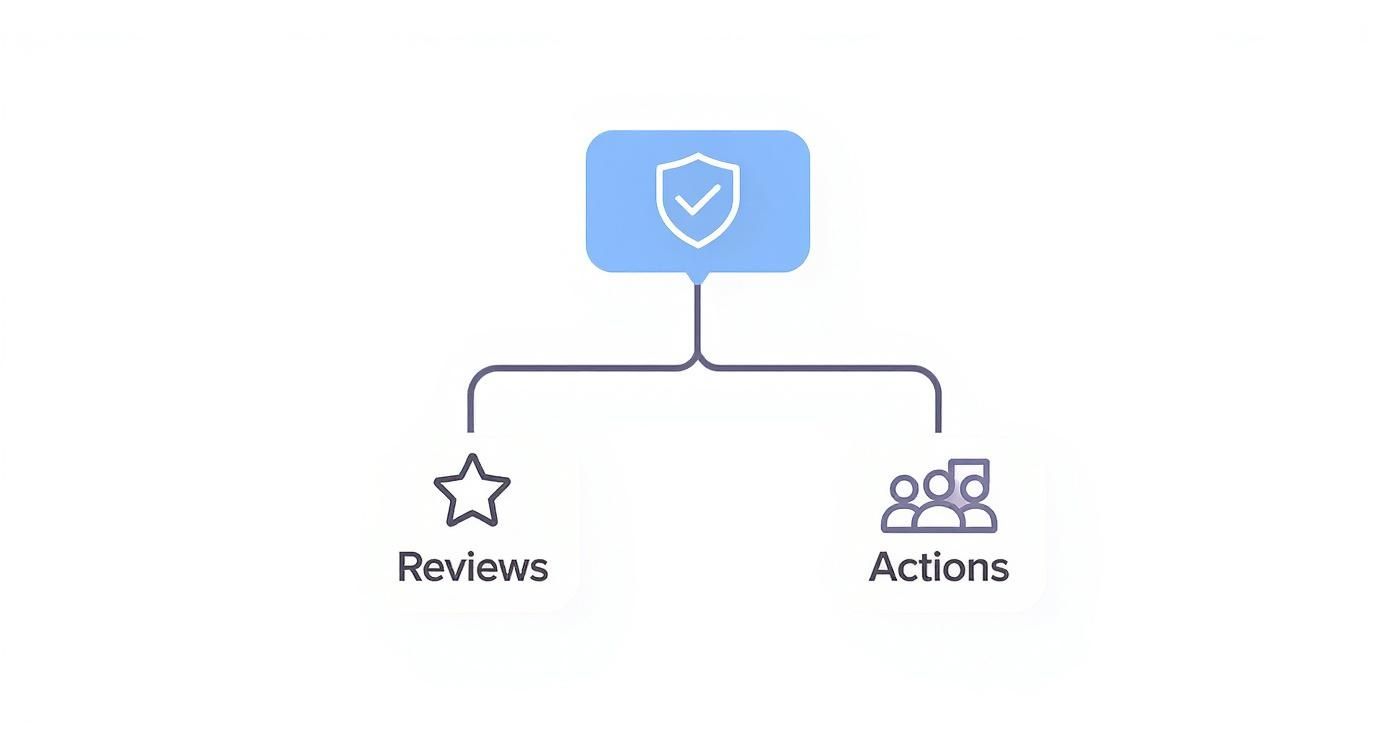
As you can see, trust is the end game. You get there by combining direct feedback from users (like reviews) with the unspoken endorsement of the crowd (what are other people doing?). Let's break down the most common types you’ll run into.
User and Expert Proof
User Proof is the classic, and for good reason—it’s the most authentic. This is what happens when your current customers basically become your best marketers through their reviews, ratings, and testimonials. This stuff is gold because it comes from real people with real experiences, making it incredibly relatable and trustworthy.
Think about it: when 97% of consumers say they check reviews before buying something, user proof is no longer a "nice-to-have." It's the absolute bedrock of online trust.
Expert Proof, on the other hand, comes from a credible, authoritative voice in your field. When a well-respected industry figure or publication gives your product a thumbs-up, their credibility rubs off on your brand. This could be a glowing review from a top blogger, a shoutout from a thought leader, or a feature in a major trade magazine.
Crowd and Celebrity Proof
Wisdom of the Crowd is all about social proof at scale. This type uses big numbers to signal that something is popular, tested, and reliable. You see it in phrases like, "Over 1 million satisfied customers" or "Join 50,000 subscribers." It taps right into our natural FOMO (fear of missing out) and reassures new buyers that they're making a safe, popular choice.
Celebrity Endorsements connect a brand with a public figure people already know and admire. The celebrity's fame grabs attention and adds a layer of aspiration to the product. It can be super effective, but it’s a strategy that lives and dies by the celebrity's reputation and whether they're a good fit for the target audience.
Friends and Certifications
Finally, we have two types of proof that are grounded in personal connections and official validation.
-
Wisdom of Friends: This is probably the most powerful form of social proof, period. A direct recommendation from a friend or family member is incredibly persuasive because it comes from a source you already trust, one with no hidden agenda. Referral programs and social sharing buttons are built specifically to tap into this powerful network effect.
-
Certifications: These are the official seals of approval from authoritative groups. Think of the security badges you see on a checkout page (like a "Verified Secure" seal) or industry awards proudly displayed on a website. They offer objective, third-party proof that a product is safe, high-quality, or legitimate.
To see how these different types come together, look at how smart brands leverage real-world customer testimonials. The best strategies often mix and match several types. For example, showcasing user-generated content is a brilliant way to blend User Proof with the Wisdom of the Crowd, which we cover in more detail in our guide to UGC content examples. It all works together to create a multi-layered and much more convincing story of trust.
Leveraging User Content to Build Genuine Trust
In a world saturated with slick, polished ads, who do people actually trust? The answer is simple: other people. The most powerful voice in your marketing isn't your own—it's your customers'.
Their authentic photos, videos, and reviews are what we call user-generated content (UGC). And it’s pure gold.
Think about it. We all know a brand-led campaign is designed to sell us something. But when a potential buyer sees a real person—someone just like them—unboxing a product and loving it, that creates an instant, genuine connection. This unfiltered perspective cuts right through the marketing noise and builds a level of trust that branded content simply can't buy.
The numbers don't lie. A massive 84% of consumers say they trust brands more when they feature UGC in their marketing. This isn't just a feel-good metric; it drives real results. Websites that showcase user content see their web conversion rates jump by an average of 29%.
Encouraging Customers to Share
So, how do you get your hands on all this amazing content? You don't need a huge budget. You just need to make sharing easy, fun, and worthwhile for your customers.
Here are a few proven ways to get the ball rolling:
- Launch a Branded Hashtag Campaign: Come up with a simple, catchy hashtag and ask customers to use it when they post. When you see great stuff, feature it on your own channels. It's a win-win.
- Run Contests and Giveaways: Nothing gets people moving like a good prize. Offer a reward for the best photo, video, or review. You’ll get a flood of awesome content in a short amount of time.
- Build a Brand Community: Create a dedicated space for your fans, like a Facebook Group or a forum. It becomes a hub where they can connect, share tips, and show off how they use your products.
By actively encouraging and celebrating what your customers create, you’re not just collecting content. You’re turning happy buyers into passionate brand advocates who create a self-sustaining cycle of social proof.
Turning Excitement Into Conversions
Once you have a steady flow of UGC, it's time to put it to work where it matters most. Sure, posting it on your social media is a great start, but the real magic happens when you weave it directly into the path to purchase. To get the most out of all the positive feedback, you might want to look into review management software to help organize and showcase it effectively.
Imagine this: a customer is browsing a product page. Right there, next to the professional product shots, are photos from other customers showing it off in their own homes. That visual confirmation is incredibly powerful. Or, what if your next ad campaign features a quick, authentic video testimonial instead of a scripted actor? That’s what stops the scroll.
This kind of UGC content creation turns genuine customer excitement into your most trustworthy and compelling marketing engine, driving both loyalty and sales.
Why Your Business Needs a Social Proof Strategy
Knowing what social proof is is one thing. But the real question is, how does it actually help your business?
Simply put, a solid social proof strategy is non-negotiable for growth because it tears down the single biggest wall between a customer and a sale: purchase anxiety.
Every single potential customer has that moment of hesitation. They ask themselves, "Is this really worth my money? Am I going to regret this?" Social proof is what quiets that voice of doubt. When shoppers see real people loving your product, it gives them the green light they need to click "buy" with confidence. This isn't just a nice-to-have; it's a direct driver of your bottom line.
Build Unshakable Brand Credibility
In a market overflowing with options, credibility is your most valuable asset. Social proof works like a constant, public endorsement of your brand's quality and trustworthiness. Every positive review, user-generated photo, and glowing case study adds another brick to that wall of proof that you deliver on your promises.
This collective validation builds a powerful reputation that ads just can't buy. It signals to new customers that choosing you is a safe bet—a smart decision that plenty of others have already made and celebrated.
A steady stream of authentic feedback creates a powerful narrative of reliability. It tells the market not just what you sell, but that you are a brand that can be trusted to deliver.
This trust is everything. In fact, research shows that a staggering 88% of consumers trust online reviews just as much as a recommendation from a close friend or family member. This peer-to-peer influence is essential for building a brand that lasts. You can find more stats on the impact of consumer trust from SMB Guide.
Drive Conversions and Improve SEO
Ultimately, the goal is to grow, and social proof is a direct line to more conversions. Websites that feature authentic user-generated content see a 29% higher web conversion rate compared to sites that don't.
Why? Because it answers questions, dissolves doubts, and shows the product being used in the real world, right at the moment someone is deciding whether to buy.
Beyond the immediate sale, this has a massive knock-on effect on your visibility. Search engines like Google are designed to prioritize businesses that seem trustworthy and popular. A healthy collection of reviews is a direct signal to them.
- Higher Click-Through Rates: Businesses with a 5-star aggregate rating can see a 28% jump in click-through rates from local search results. People are just more likely to click on the option with more stars.
- More Relevant Content: Reviews are a goldmine of keywords and phrases that real customers use. This naturally enriches your product pages and helps you rank for all sorts of long-tail searches you might have missed.
- Increased User Engagement: A lively review section keeps people on your page longer. This sends positive signals to search algorithms that your content is valuable and engaging.
By actively collecting and showcasing social proof, you create a powerful feedback loop. You don't just turn more visitors into customers—you also boost your organic reach, which brings even more qualified traffic to your door over time.
How Leading Brands Master Social Proof
It’s one thing to understand the theory of social proof. It’s another thing entirely to see it in action, done right. The world’s biggest brands don’t just sprinkle in a testimonial here and there—they weave social proof into the very fabric of how you experience their products.
By looking at their playbooks, we can see exactly how they build that magnetic sense of trust that drives people to buy.

These companies are masters of layering. They know a single testimonial is good, but combining it with user reviews, expert stamps of approval, and the feeling that "everyone's doing it" is downright unstoppable.
Let's break down a few of the greats.
Amazon: The King of User Proof
When you think of online reviews, you think of Amazon. It’s no accident. The e-commerce giant literally built its empire on the back of user proof, turning every product page into a town square of customer chatter. The star ratings, the detailed reviews, the customer photos—it's the first place we all look.
Why does this work so well? It melts away our natural hesitation before buying something new. By showing the unfiltered, real-world experiences of hundreds (or thousands) of people who’ve already taken the plunge, Amazon gives us the confidence to click "Add to Cart." It’s the wisdom of the crowd, scaled for the internet.
Slack and Expert Authority
For B2B companies, winning over savvy decision-makers is the whole game. The SaaS powerhouse Slack nails this by plastering the logos of its biggest clients—think Airbnb, Target, and Uber—right on its homepage. This is a simple, yet devastatingly effective, use of expert proof.
The psychology here is immediate and powerful. You think, "If these massive, successful companies trust Slack for their internal communication, then it's got to be good enough for my business." That borrowed credibility gives Slack an instant status boost, building a foundation of trust before you even sign up for a trial.
Instagram and the Power of UGC
In the world of beauty and fashion, seeing is believing. That makes Instagram the perfect arena for a different kind of social proof: user-generated content (UGC). Brands have gotten brilliant at encouraging customers to share photos with a branded hashtag, effectively turning their audience into a marketing army.
Glossier, for instance, built its cult following by featuring real customers—not supermodels—on its feed. This strategy works because it feels real. We're tired of glossy, perfect ads. In fact, research shows that 79% of people say UGC has a huge impact on what they decide to buy.
By turning their feeds into a gallery of happy, real-life customers, these brands create a vibrant community that feels less like a marketing ploy and more like a movement.
By featuring real people, brands transform their marketing from a monologue into a conversation. This authentic approach not only showcases the product but also celebrates the community around it.
As you can see, the best social proof strategies aren't one-size-fits-all. They're carefully chosen for a specific audience on a specific platform. Whether it’s through mountains of reviews, logos from industry titans, or authentic customer photos, the goal is always the same: let other people make the case for you.
Want to see how companies are applying these concepts in their ads? Check out these powerful testimonial ads examples to see how other brands are putting these ideas into practice.
Common Social Proof Mistakes (And How to Fix Them)
Social proof is a seriously powerful tool, but it's not foolproof. Mess it up, and you can actually destroy the trust you're trying so hard to build. It’s not just about a strategy failing to work; a bad approach can actively damage your brand.
Let’s be real: one of the biggest temptations is using fake or misleading social proof. Buying reviews or just making up testimonials might feel like a quick win, but today's customers can smell a fake from a mile away. Once they figure it out, that trust is gone. Forever.
Another easy trap to fall into is using negative social proof. This is when you accidentally highlight a bad behavior, hoping to stop it. Think of a sign in a museum that says, “Many visitors have been stealing artifacts.” What does that really say? It signals that stealing is a pretty common thing to do here, which might just encourage more people to do it.
Instead, you always want to focus on the positive actions you want people to take.
Don't Put All Your Eggs in One Basket
Relying on just one type of social proof is a huge gamble. If you’ve built your entire credibility on a few Instagram influencer posts, you're completely missing the people who trust detailed customer reviews or in-depth expert case studies. A layered approach is always stronger.
Try to build a healthy mix of different proof types:
- User Reviews: This is the foundation of trust for most brands. Make it easy for customers to leave reviews on your site and third-party platforms.
- Expert Endorsements: In certain fields, especially tech or B2B, a single nod from a respected expert can carry more weight than a hundred user reviews.
- Case Studies: For B2B brands, nothing beats a detailed story showing a potential client exactly how you solved a real problem for a real company.
The idea is to build up layers of credibility that connect with different kinds of buyers on their own terms.
The best social proof strategies are never one-dimensional. They weave together the voices of everyday customers, industry experts, and hard data to tell a story of value that’s impossible to ignore.
You're Ignoring the Bad Reviews
This one is a massive own-goal. A page full of nothing but glowing, five-star reviews doesn't feel real—it feels suspicious. Seeing a few less-than-perfect reviews (and how you handle them) is actually an opportunity. It shows you’re transparent and committed to your customers.
Make it a policy to respond publicly and professionally to any criticism. Offer a solution, show you're actually listening, and thank them for the feedback. This simple act turns a potential negative into a public demonstration of your fantastic customer service.
After all, products with five or more reviews see a 270% higher purchase rate, and having a realistic mix of feedback makes all your positive reviews feel that much more genuine. You can find more stats on the impact of review volume on Datapins.com.
Your Social Proof Questions, Answered
How can a brand-new business get social proof?
This is a classic chicken-and-egg problem, but it's solvable. Before you have customers, you can lean on the expertise of the founders. Highlight their credentials, past successes, or industry experience.
Another great starting point is to offer incentives for your very first customers to leave reviews or share their experiences. Think discounts on future purchases or early access to new features. This helps you build that initial momentum.
Isn't social proof just another word for testimonials?
Not quite. A testimonial is a specific type of social proof, but it's just one piece of a much bigger picture.
Think of social proof as the entire ecosystem of trust signals. It includes everything from testimonials and user reviews to media mentions, expert endorsements, and even simple things like the number of people using your product. A testimonial is a single voice; social proof is the roar of the crowd.
What should I do about negative reviews?
It might feel tempting to ignore or delete them, but don't. The best move is to respond publicly, quickly, and professionally.
Addressing the issue head-on shows everyone watching that you're listening and you care. It turns a potential negative into a massive positive, demonstrating your commitment to customer satisfaction and building trust with prospects who see you handle criticism with grace.