How to Make Ads for Dropshipping That Convert
Learn how to make ads for dropshipping that drive sales. Our guide covers creative, targeting, and scaling strategies for Facebook, TikTok, and Google.
Great dropshipping ads don’t just happen. They’re built on a solid foundation of research and setup before you even think about hitting "publish."
This prep work is what separates the pros from the people who just burn through their ad budget. It's about knowing exactly who you're talking to, what your competitors are up to, and having the right tools in place to track every single click and conversion.
Building Your Foundation for Profitable Ads
Jumping straight into making ads without a clear strategy is a recipe for disaster. It's like trying to build a house without a blueprint—you might end up with something, but it's not going to be stable or effective. The most successful dropshippers I know are meticulous about this prep phase.
This whole process really boils down to three key pillars: getting inside your customer's head, spying on your competition (ethically, of course), and getting your tech stack right. If you skimp on any of these, you're just gambling with your ad spend.
Define Your Ideal Customer Avatar
You have to go way beyond basic demographics like age and gender. I'm talking about creating a full-blown customer avatar—a detailed profile of your perfect buyer. What keeps them up at night? What are their real motivations? Where do they actually hang out online?
Answering these questions is what allows you to write copy that feels like you're reading their mind. If you need a hand with this, our guide on how to identify your target audience is a great place to start.
Let's say you're selling a portable blender. Your avatar isn't just "health-conscious women aged 25-40." That's too generic. A better avatar is "Sarah, a 32-year-old marketing manager who’s always rushing in the morning and struggles to get a healthy breakfast. She follows fitness influencers on Instagram, listens to podcasts on her commute, and values convenience over everything." See the difference? Now you know exactly how to talk to her.
Analyze Your Competitors
Why waste money figuring things out from scratch when your competitors have already spent a fortune doing it for you? Seriously, their ads are a goldmine of information.
Start looking for patterns in what they're running. Pay attention to:
- Ad Angles: Are they leading with a problem the product solves, a specific benefit, or just cool features?
- Creative Style: Is it polished, professional video? Or are they leaning into raw, user-generated content (UGC)?
- Call-to-Action (CTA): Are they pushing for a "Shop Now," "Learn More," or maybe something softer like "Take The Quiz"? A complete guide to Facebook Ads for dropshipping can offer more insight into effective CTAs.
This isn't about ripping off their ads. It’s about understanding the landscape. If every ad in your niche is loud and flashy, maybe a clean, minimalist approach will cut through the noise.
Key Takeaway: Your goal here is to spot the trends, see what’s already resonating with your shared audience, and find a gap. You want to create something that feels familiar enough to be trustworthy but different enough to get noticed.
Set Up Essential Tracking Tools
If you’re not tracking your data, you're just guessing. Setting up tools like the Meta Pixel (for Facebook and Instagram) and Google Analytics is completely non-negotiable. These are the tools that will tell you what's working and what's not, allowing you to make smart, data-driven decisions instead of emotional ones.
They are the bedrock of any successful ad campaign.
This simple workflow shows how these pieces fit together to create a strong foundation for your ads.
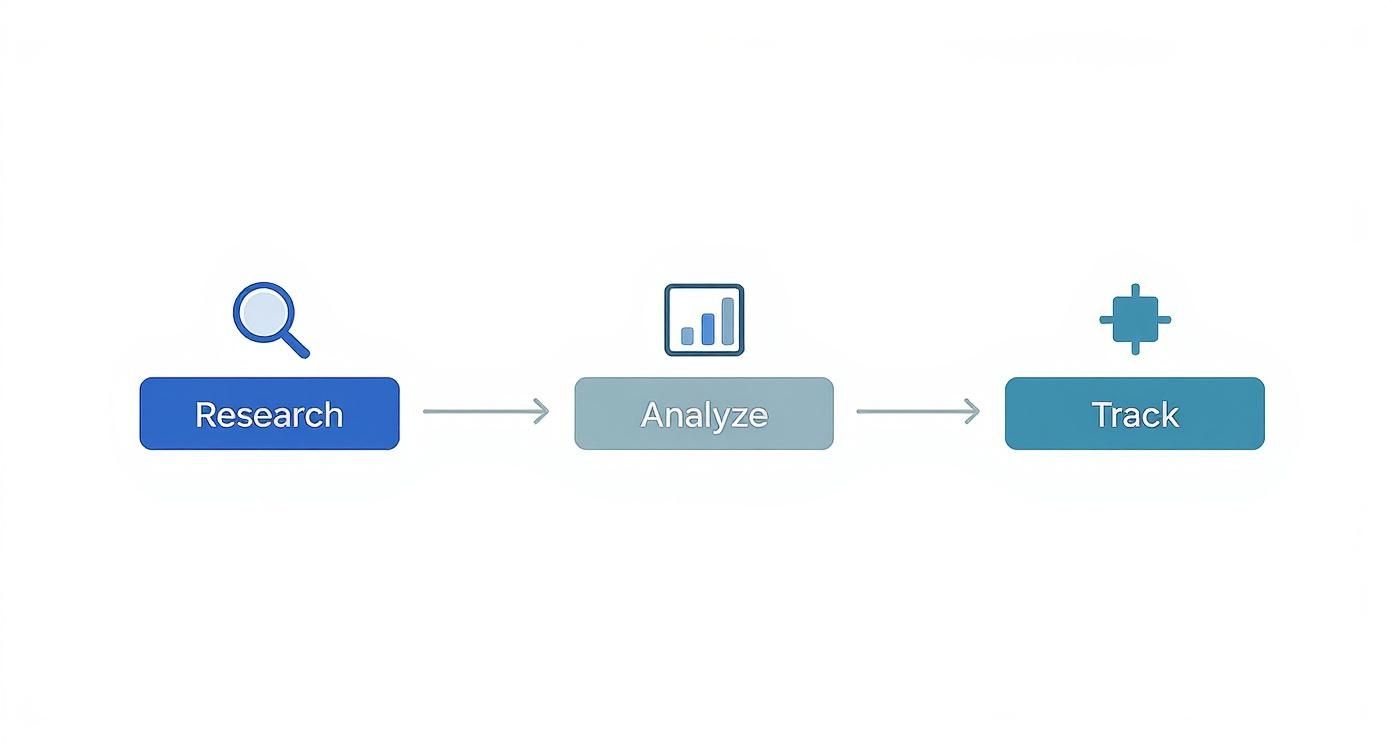
Getting this right ensures every campaign you launch is built on a solid base of research, analysis, and real data.
Choose The Right Ad Platform
Not all platforms are created equal, and where you run your ads matters—a lot. Your choice should come down to where your ideal customer spends their time. Don't just default to Facebook because everyone else does.
Here’s a quick rundown to help you decide where to put your first dollars.
Ad Platform Selection Guide for Dropshippers
| Platform | Best For | Audience | Ad Format Strength | | :--- | :--- | :--- | :--- | | Facebook | Broad appeal, problem-solving products | Wide range, especially 25-55+ | Video, Image, Carousel | | Instagram | Visually-driven, aesthetic products | Younger demographic, 18-34 | Reels, Stories, Carousels | | TikTok | Viral, trend-based, and UGC-style products | Gen Z and Millennials, 16-30 | Short-form video (TikTok Spark Ads) | | Pinterest | Home, fashion, DIY, and visual discovery products | Predominantly female, high purchase intent | Static Pins, Video Pins, Idea Pins | | Google Ads | High-intent, problem-aware searchers | Anyone actively searching for a solution | Search, Shopping, Performance Max |
Think about your product and your "Sarah" avatar. Is she scrolling through aesthetic home decor on Pinterest or looking for quick tips on TikTok? Meet your customers where they are, and your ads will have a much better chance of landing.
Creating Ad Content That Stops the Scroll
Let's be blunt: your ad creative is everything. It's the one thing that will make someone slam the brakes on their endless doom-scrolling and actually pay attention to what you're selling.
If you’re thinking about slick, corporate-style ads, stop right there. That stuff gets ignored. On platforms like TikTok and Instagram, authenticity is king. You want to create content that looks like it belongs in your customer's feed, not something that screams "I'M AN AD!"
Think less like a giant brand and more like a real person sharing a cool find. This is why a user-generated content (UGC) style is so powerful—it feels genuine, building instant trust and making people curious.
The Winning Video Ad Formula
You don't need a Hollywood budget to make an effective dropshipping ad. Honestly, your iPhone and some decent lighting are more than enough. The best video ads follow a simple but brutally effective structure designed to grab attention and get a click in just a few seconds.
Here’s the framework that consistently works:
- The 3-Second Hook: This is your first, and maybe only, chance. You need to hit them with your most captivating visual or a bold statement that speaks directly to a pain point. Selling a portable stain remover? Start with a dramatic slow-mo shot of red wine spilling all over a crisp white shirt. It's impossible to ignore.
- The Problem and Solution: Right after the hook, show the problem in action. Following our example, you'd show the panic of a ruined shirt. Then, BAM—introduce your product and show it making the stain vanish. Seeing is believing, and this visual proof crushes any wall of text.
- The Clear Call-to-Action (CTA): Never, ever end your video without telling people exactly what to do next. Don’t be subtle. A direct "Shop Now and Get 50% Off!" or "Tap the link in our bio to get yours!" leaves zero room for guesswork.
Want to go deeper on this? We've got a whole guide on how to make video ads that get results. This formula is your launchpad.
Writing Copy That Sells
While your video is the hook, your copy is what reels them in. The text that accompanies your ad needs to be short, sharp, and persuasive. One of the oldest and most reliable copywriting formulas for this is AIDA.
AIDA stands for Attention, Interest, Desire, and Action. It’s a simple mental checklist that guides your customer from "what's this?" to "I need this now."
Let's see how it works for a "smart" coffee mug that keeps drinks hot.
- Attention: “Tired of your coffee going cold before you even get through your emails?” This line immediately grabs anyone who’s ever faced this daily frustration.
- Interest: “Our smart mug keeps your drink at the perfect temp for up to 3 hours, right down to the last sip.” This presents the core benefit and gets them nodding along.
- Desire: “Imagine sipping perfectly hot coffee from your first task to your mid-morning meeting. No more nasty microwaved coffee, no more waste.” This paints a vivid picture, making them want the feeling your product delivers.
- Action: “Click ‘Shop Now’ to grab yours with a 25% launch discount. Your perfect cup of coffee is waiting!” This is the final push—clear, urgent, and direct.
When you combine a scroll-stopping video with copy that follows a proven framework like AIDA, you’ve created a powerful one-two punch that turns casual scrollers into paying customers.
Launching Your First Ad Campaigns
Alright, your creative is polished and your research is done. It's go time. This is where the rubber meets the road, but a sloppy campaign setup can kneecap your efforts before the algorithm even has a chance to find your buyers.
Here's a classic rookie mistake: choosing 'Traffic' or 'Engagement' as a campaign objective because the clicks seem cheaper. Don't fall for it. You're here to make sales, period. So you need to tell the ad platform exactly that.
Always, and I mean always, select a 'Sales' or 'Conversions' objective. This is you telling the algorithm, "Go find me people who will actually pull out their credit cards," not just people who mindlessly click or like. You’re training it to find you money, not just vanity metrics.
Choosing Your Targeting Strategy
The sweet spot with targeting is reaching the right people without getting so specific that your ad costs go through the roof. Both Facebook and TikTok have incredible tools for this, but your first move here really sets the tone.
A good place to start is by layering interests. Let's say you're selling a fancy, tech-forward pet toy. You could target users interested in "Dog toys" AND "Gadgets." That simple 'AND' instantly creates a much more qualified audience than just blasting your ad to every dog owner on the platform.
But the real power move? Lookalike Audiences. This is where the platforms do the heavy lifting for you by building an audience based on your own data, like:
- A list of your past customers
- People who have visited your website (your pixel data)
- Users who have engaged with your social media profiles
You can literally upload a list of your best customers and ask Facebook or TikTok to find millions of new users who look and act just like them online. This is the secret sauce for scaling dropshipping ads effectively.
Structuring Your Budget and Campaign
How you spend your money is just as critical as who you spend it on. The big debate often boils down to two methods: Campaign Budget Optimization (CBO) and Ad Set Budget (ABO).
Expert Tip: Don't overthink the CBO vs. ABO battle in the beginning. Start with ABO for testing. It lets you assign a specific budget to each audience, giving you total control. This is exactly what you want when you're trying to figure out which group of people actually responds to your ad.
Using ABO in the testing phase gives you clean, undeniable data. Once you have a clear winner—an ad set that's consistently bringing in profitable sales—then you can move it over to a CBO campaign and let the algorithm work its magic to scale up.
Here’s a simple way to break it down:
- Ad Set Budget (ABO): This is for your testing phase. You set a specific daily budget for each audience (e.g., $20/day). This guarantees every audience gets a fair chance to prove itself.
- Campaign Budget Optimization (CBO): This is for scaling what works. You set one budget for the whole campaign, and the platform automatically funnels more cash to the best-performing ad sets in real time.
Remember, your paid ads don't exist in a vacuum. The most successful dropshipping stores weave them into a broader marketing strategy. In fact, dropshipping businesses with an active social media presence pull in about 32% more revenue than those that don't. When you combine paid search, which drives 33% of traffic, with organic search, which accounts for a massive 53%, you create a seriously powerful growth engine. You can dig into more dropshipping statistics to see just how these channels all fit together.
Optimizing Your Ads for Better Performance
Launching your ads is just the starting gun, not the finish line. The real work—and where the profits are actually made—is in the day-to-day grind of optimization. It's about learning to read the data, understand what it's telling you, and making smart tweaks to get better results.
Too many new dropshippers fall into the "set it and forget it" trap. They launch a campaign, cross their fingers, and hope for the best. That almost never works. The secret is building a simple, consistent routine for checking your ads and taking action based on what the numbers are showing you.
Interpreting Your Key Ad Metrics
Your ad dashboard is flooded with numbers, but you don't need to track every single one. Getting bogged down in vanity metrics is a classic rookie mistake. To really understand what's happening, you only need to focus on the numbers that directly impact your bank account.
These are the three big ones you need to live and breathe:
- Click-Through Rate (CTR): This is the percentage of people who saw your ad and actually clicked it. A low CTR is a huge red flag—it usually means your creative isn't grabbing attention or your targeting is way off.
- Cost Per Acquisition (CPA): Simply put, this is what it costs you to get one customer. If your CPA is higher than your product's profit margin, you're losing money on every sale. It's that simple.
- Return On Ad Spend (ROAS): This is the ultimate scorecard for your ad campaigns. It shows you exactly how much money you're making for every single dollar you spend. To get a clear picture of your profitability, you need to know how to calculate your Return on Ad Spend (ROAS).
These metrics don't live in a vacuum; they tell a story together. For example, a super high CTR but a terrible CPA is a classic sign of a problem after the click. Your ad is doing its job, but something on your product page—maybe the price, the shipping times, or the checkout process—is scaring customers away.
To help you diagnose issues quickly, here’s a quick-reference table for the most important metrics.
Key Dropshipping Ad Metrics and What They Mean
| Metric | Good Benchmark | What It Indicates | Action to Take if Low | | :--- | :--- | :--- | :--- | | Click-Through Rate (CTR) | Above 1.5% | Your ad creative and targeting are resonating with the audience. | Test new ad copy, images, or videos. Revisit your audience targeting. | | Cost Per Click (CPC) | Below $1.00 | You're getting traffic to your site at an efficient price. | Improve your ad's CTR. A more engaging ad often leads to a lower CPC. | | Cost Per Acquisition (CPA) | Below your profit margin | Your campaign is acquiring customers profitably. | Improve your website's conversion rate or pause low-performing ad sets. | | Return On Ad Spend (ROAS) | Above 3.0x | Your ad spend is generating a healthy, profitable return. | Kill unprofitable ads/ad sets. Scale the budget for your winning campaigns. |
Think of this table as your ad performance cheat sheet. Keep these benchmarks in mind as you review your campaigns.
Your Daily Ad Check-In Routine
Building a habit of checking your ads for just 5-10 minutes every morning can save you a fortune. This simple routine helps you spot bleeding campaigns early and double down on what's working before a small problem turns into a major loss.
Here's a simple, effective workflow:
- Start Broad: Look at the overall campaign level. Was yesterday profitable? Check your total ROAS first.
- Zoom into Ad Sets: Now, dive into each ad set (your audiences). Is one audience outperforming the others? It might be time to turn off a clear loser that's just burning cash.
- Inspect the Ads: Finally, look at the individual ad creatives. Is one video getting a much lower CTR than the others in the same ad set? It's probably not resonating. Pause it.
Pro Tip: Don't be too quick to pull the trigger. Unless an ad is spending money with zero results, give it 2-3 days to collect data before you kill it. You need to look for trends, not react to a single bad day.
This daily check-in isn't just about cutting your losses. It's about finding your winners early so you can feed them more budget and scale up.
The truth is that while dropshipping can be incredibly lucrative, success is never guaranteed. The most successful sellers pair a sharp ad strategy with an obsessive focus on what happens after the click. If your ads are bringing in traffic but you're not seeing sales, it's time to dig into your website with these conversion rate optimization tips and start turning more of those clicks into customers.
Scaling Your Winning Ads Profitably
So, you found a winner. An ad that’s actually bringing in sales, and profitable ones at that. It’s a huge moment. The first instinct for most people is to slam the gas pedal, crank up the budget, and dream about the sales flooding in.
But hold on. Scaling too fast, or the wrong way, is the single quickest way to kill a great campaign. You'll tank your ROAS and be right back at square one.
The secret is to scale methodically. You have to grow your reach without sacrificing the very profitability that made the ad a "winner" in the first place. This really comes down to two main strategies: vertical scaling and horizontal scaling.
Think of it as drilling deeper versus drilling wider.
Understanding Vertical Scaling
Vertical scaling is the most straightforward approach. You're simply increasing the budget on the ad set that's already working. The key word here, though, is gradually.
If you make a huge, sudden jump in your budget, you risk shocking the platform's algorithm. This can knock your ad set right back into the learning phase, and just like that, the performance you loved is gone.
A safe, battle-tested rule of thumb is to increase your daily budget by no more than 20% every 24-48 hours. If an ad set is crushing it at $50/day, bump it to $60. Let it run for a day or two, make sure the metrics hold steady, and then you can bump it again. This slow-and-steady method lets the algorithm adjust without panicking.
Expanding with Horizontal Scaling
While vertical scaling goes deeper with one audience, horizontal scaling goes wider. This is where you take your winning ad creative and duplicate it to target brand-new, similar audiences. You're basically cloning what works and putting it in front of fresh sets of eyes.
Here are a few ways I like to do this:
- New Lookalike Audiences: Was a 1% lookalike of your past buyers a hit? Great. Duplicate the ad set and test it on a 1-2% or 2-3% lookalike audience.
- Different Interests: Find interests that are related but not identical. If you scored big with people interested in "hiking gear," try duplicating the campaign for audiences interested in "camping" or "national parks."
- Broader Demographics: Maybe your ad resonated with men aged 25-34. Perfect. Clone that ad set and see how it does with men aged 35-44.
Key Insight: Horizontal scaling is a fantastic way to minimize risk. By duplicating your winning ad set, you leave the original untouched. If a new audience turns out to be a dud, you just turn it off. No harm, no foul, and your original winner keeps humming along.
Building Your Retargeting Machine
Look, scaling isn't just about finding new customers. It’s also about squeezing every last drop of value from the traffic you already paid for. This is where a rock-solid retargeting engine comes in.
Consider this: roughly 97% of first-time visitors to an e-commerce store leave without buying anything. Getting those people to come back is pure profit potential.
Your retargeting campaigns need to speak directly to this "warm" traffic with tailored messages.
- Abandoned Carts: This is low-hanging fruit. Hit these users with a dynamic ad showing them the exact product they left in their cart. A little nudge like, "Still thinking it over?" or a small discount code can work wonders here.
- Website Visitors: For people who browsed but didn't add to cart, show them a different angle. Maybe it's a customer testimonial video or an ad that highlights a key feature they might have missed. They're already interested; your job is to build trust and a little urgency.
When you combine controlled vertical scaling, smart horizontal expansion, and a relentless retargeting system, you build a complete growth strategy. It's how you scale your business profitably without burning out your best ads.
Common Dropshipping Ad Questions
Jumping into dropshipping ads can feel like you're trying to piece together a puzzle with half the pieces missing. Everyone seems to have a different opinion. Let’s cut through the noise and tackle the questions that really hang people up.
First up, the big one: money. How much should you actually spend when you’re just getting your feet wet?
There’s no one-size-fits-all answer, but you need to budget enough to actually learn something. Aim for a daily budget that gets you at least 1,000 impressions on an ad set. For platforms like Facebook or TikTok, a starting point of $20-$30 per day for each ad set you're testing is a solid benchmark.
This gives the algorithm enough juice to start finding your ideal customers without you having to bet the farm right out of the gate.
How Long Should My Video Ads Be
Another question I hear all the time is about video length. With attention spans being what they are, shorter is almost always your best bet, especially when you're trying to catch the eye of new customers on TikTok or Instagram Reels.
The sweet spot for these top-of-funnel ads is somewhere between 15 and 30 seconds. Your entire job in that short window is to land a killer hook, show off the product's value, and hit them with a clear call-to-action before they can even think about scrolling away.
But the "right" length really depends on who you're talking to:
- Prospecting Ads: Keep it short and snappy. Think 15-30 seconds.
- Retargeting Ads: You've got a little more room to play here. For warmer audiences who already know you, you can go a bit longer—say, 30-60 seconds—with a deeper dive like a testimonial or a more detailed demo.
Honestly, the exact second count doesn't matter as much as the ad's ability to keep someone watching. If every single second serves a purpose and keeps them hooked, then it's the perfect length.
Do I Need a Professional Camera
Absolutely not. In fact, a lot of the time, those super polished, high-production-value ads can actually backfire on social media. Why? Because they scream "I'm an ad!" and people have trained themselves to scroll right past them.
Your smartphone is genuinely your best friend here. A video shot on a new-ish phone feels more authentic and native to the feed, which is massive for building trust.
Instead of obsessing over expensive camera gear, focus on getting the basics right: good lighting, clear audio, and a story that connects. Authenticity will beat a big budget almost every time.
Ready to create scroll-stopping dropshipping ads without the headache? ViewPrinter gives you the AI tools to generate engaging videos, from viral hooks to product demos, in minutes. Build your next winning campaign at https://viewprinter.tech.