How to Reduce Customer Acquisition Cost and Maximize Growth
Learn how to reduce customer acquisition cost with proven strategies. This guide covers funnel optimization, LTV, and smart targeting to boost your ROI.
Cutting your customer acquisition cost isn't about one magic bullet. It’s a combination of auditing your spending, fine-tuning your marketing funnel, and boosting your customer lifetime value. It all starts with getting an honest look at what you’re really spending to get a new customer. From there, you can systematically improve how you convert and retain them, making every dollar you spend work smarter.
Auditing Your True Customer Acquisition Cost
Before you can slash your CAC, you have to know what it is—down to the penny. Too many businesses skate by on surface-level numbers, completely missing the hidden costs that bloat their actual CAC. A deep, thorough audit is the only real starting point for sustainable growth.
This isn't just about adding up your ad spend. It's a full-blown diagnostic of every single cost tied to getting a new customer in the door, including all the direct and indirect expenses.
Gathering Your Total Expenses
First things first, you need to round up every marketing and sales cost from a specific period, whether that's a quarter or a full year. Be ruthless here; the small stuff adds up faster than you think.
Your expense list should include:
- Ad Spend: The obvious one. This is everything you're paying for Google Ads, Meta campaigns, sponsored content, and any other paid channel.
- Salaries: The portion of your marketing and sales teams' salaries that's dedicated to acquiring new customers.
- Tools and Software: All those subscriptions for your CRM, marketing automation, analytics platforms, and design software.
- Creative and Content Production: The cost of actually making the ads, blog posts, videos, and other assets that fuel your campaigns.
- Freelancer and Agency Fees: Any cash you're paying out to external partners for their help with acquisition.
This exercise gives you a crystal-clear picture of your total investment. It’s also a great chance to spot easy wins, like finding ways of reducing Amazon PPC ad spend without hurting your performance.
Segmenting Data for Deeper Insights
Okay, you've got your total expense number. Now the real work starts. The goal is to get away from a single, blended CAC that tells you almost nothing. You need to segment your costs to see which channels and campaigns are actually making you money.
Start slicing up your total costs and new customer counts by:
- Marketing Channel: What’s your CAC on Facebook ads versus what you get from organic search?
- Specific Campaigns: Did your Black Friday push bring in customers more cheaply than your summer sale?
- Customer Persona: Are you spending more to land enterprise clients compared to small business owners?
This level of detail is non-negotiable. It helps you understand what's really driving results, a topic we dive into deeper in our guide on how to measure advertising effectiveness. This is how you find out where your budget is fueling real growth and where it's just being wasted.
Key Takeaway: A blended CAC hides the truth. Segmenting your data by channel, campaign, and persona is the only way to know what’s actually working and make informed decisions to lower your costs.
This simple three-step process—gathering expenses, segmenting your data, and setting benchmarks—gives you a solid framework for auditing your true CAC.
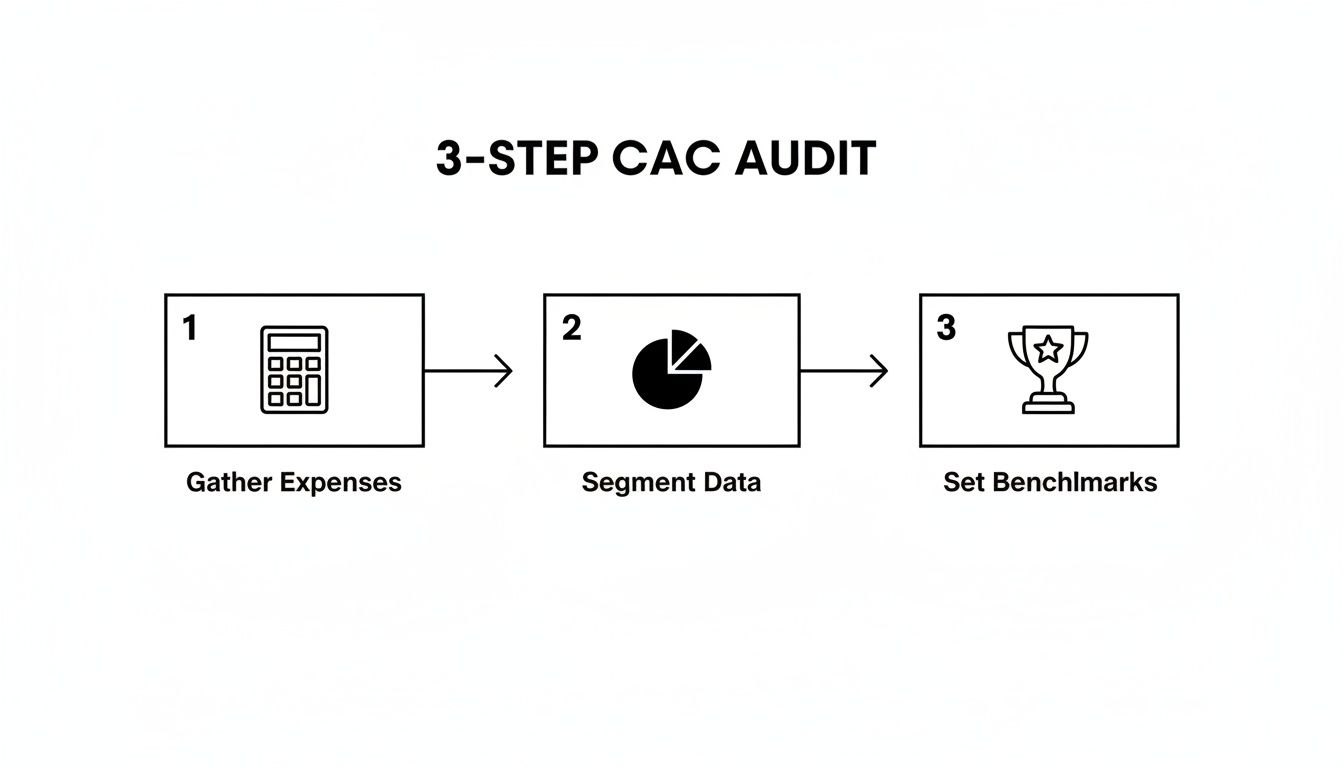
This flow really drives home the need for a systematic approach, taking you from raw numbers to actionable insights that will shape your entire cost-reduction strategy.
To help you get started, here’s a simple template to organize your findings.
CAC Audit Template Key Metrics by Channel
| Marketing Channel | Total Spend | New Customers Acquired | Calculated CAC | Notes/Observations | | :--- | :--- | :--- | :--- | :--- | | Google Ads | $10,000 | 200 | $50 | High intent, but CPCs rising. | | Meta Ads | $15,000 | 350 | $42.85 | Top performer for lead volume. | | Organic/SEO | $5,000 | 150 | $33.33 | Lowest CAC, but slow to scale. | | Influencer Marketing | $8,000 | 100 | $80 | High CAC, need to vet partners better. |
This kind of table instantly clarifies which channels are your workhorses and which might need rethinking or optimization.
Setting Realistic Benchmarks
Forget about generic industry averages you find online. A "good" CAC is completely relative to your business model—specifically, your Customer Lifetime Value (LTV). Once you have a clear, segmented picture of your acquisition costs, you can set meaningful internal benchmarks to beat.
A February 2025 MAC Report found that over 40% of credit union executives didn't have clear visibility into their CAC. That’s a huge blind spot. On the flip side, businesses using AI analytics for sharper targeting are seeing much better spending efficiency and higher conversion rates. This points to a wider trend: combining multiple channels, like paid ads on Google and Meta with a strong organic SEO game, is way more effective at lowering costs than just dumping your budget into one place. This data-driven mindset lets you set a clear starting line for the real optimization work ahead.
Plug the Leaks in Your Funnel to Boost Conversions
Getting traffic to your site is only half the job. If those hard-won visitors land on a confusing, slow, or frustrating website, you’re essentially pouring your ad spend into a leaky bucket.
Truth is, the fastest way to slash your customer acquisition cost often isn't about spending less on ads—it's about converting more of the people you’ve already paid to get there.
This whole process is called Conversion Rate Optimization (CRO), and it’s all about systematically fixing the leaks in your marketing funnel. Even tiny improvements here can have a massive impact on your bottom line. It's an essential discipline for any business serious about scaling profitably.
Create a Frictionless User Journey
Every extra click, unnecessary form field, or confusing instruction is a potential exit point for your customer. Your mission is to create the most direct, painless path from curious prospect to happy buyer. Think of your website as a highway; you want to eliminate every single traffic jam and confusing detour.
Start by walking through the key stages of your own customer journey:
- Landing Page: Does it instantly deliver on the promise from your ad? Is the call-to-action (CTA) impossible to miss?
- Product Pages: Are the images crisp and professional? Is your copy focused on benefits (what's in it for them) instead of just features?
- Checkout Process: How few steps can a user take to complete a purchase? Do you offer a guest checkout option?
I once worked with an e-commerce brand that saw a 15% drop in cart abandonment just by removing three optional fields from their checkout form and adding one-click payment options like Apple Pay and Shop Pay. It’s the simple stuff that often moves the needle the most.
A/B Test Your Way to a Lower CAC
Guesswork is expensive. Instead of just thinking you know what will work, you need to be constantly testing different elements to see what actually resonates with your audience. This is where A/B testing becomes your best friend in the fight against high CAC.
You don't have to rebuild your entire site. Just focus on the high-impact stuff first—your landing page headline, the color of your CTA button, or the main image on your product page. Run a controlled experiment where you show version A to 50% of your audience and version B to the other 50%, then see which one wins.
Pro Tip: Only change one thing at a time. If you test a new headline and a new button color in the same experiment, you'll never know which change actually caused the lift in conversions.
This data-driven approach takes the guesswork and ego out of the equation. You're letting your customers tell you exactly what they want. For a deeper dive, check out our guide on the most important conversion rate optimization tips you can use today.
Build Trust with Smarter Messaging
A great design and a smooth user experience are crucial, but they're nothing without powerful copy and solid trust signals. Your messaging has to build rapport fast, handle objections before they even come up, and make the customer feel completely confident about buying from you.
Effective messaging boils down to a few key things:
- A Crystal-Clear Value Prop: A visitor should know exactly what you do and why it matters within five seconds of hitting your site.
- Powerful Social Proof: Customer reviews, testimonials, and case studies are your secret weapons. They show that real people have bought from you and were happy they did.
- Visible Trust Badges: Things like security seals, money-back guarantees, or free shipping banners can dramatically reduce that last-minute hesitation at checkout.
In the world of e-commerce, customer acquisition costs have skyrocketed by a staggering 222% over the last decade, jumping from an average of $9 in 2013 to a projected $29 in 2025.
Brands that are winning are the ones obsessed with CRO. Simple improvements—like boosting site speed and simplifying checkout—can literally double a site's conversion rate from 2% to 4%. When that happens, you’ve just cut your acquisition cost in half. By focusing on optimizing your funnel, you make every dollar you spend work twice as hard.
Refining Your Targeting and Creative Strategy
Once you've plugged the major leaks in your funnel, your next big lever for dropping CAC is to get smarter about who you're talking to and what you're saying.
It’s a painfully simple truth in marketing: spending money to reach people who will never buy from you is the fastest way to burn cash and bloat your acquisition costs.
Great marketing isn't about shouting your message to the biggest crowd you can find. It's about whispering it to the right person at exactly the right moment. This takes a deep, almost obsessive understanding of your ideal customer and a commitment to creating ads that actually resonate.
Go Way Beyond Basic Demographics
So many brands get stuck at basic demographic targeting—age, gender, location. While that’s a decent starting point, it’s far too broad to be cost-effective in today’s ad landscape. If you're serious about lowering CAC, you have to dig deeper into psychographics and behavior.
This means building out a detailed Ideal Customer Profile (ICP) that answers the real questions:
- What are their biggest frustrations? Not just in general, but the specific pain points your product actually solves.
- What truly motivates them? What are the core aspirations that drive them to even look for a solution in your category?
- Where do they actually hang out online? Are they doom-scrolling TikTok, reading niche blogs, or plugged into specific podcasts?
- What kind of language do they use? Do they respond to humor, hard data, or emotional storytelling?
By getting this granular, you stop targeting "women aged 25-40." Instead, you start targeting "millennial project managers who feel buried in disorganized workflows and are actively looking for tools to help their team collaborate better." That level of specificity is where you find efficiency.
Sharpen Your Ad Targeting
With a crystal-clear ICP in hand, you can build much smarter audiences on platforms like Meta and Google. Instead of casting a wide net, you can create hyper-targeted campaigns that speak directly to people with high intent. This is a game-changer for reducing acquisition costs.
On Meta, for instance, you can start layering targeting options to zero in on your perfect audience. You could target users who have shown interest in your direct competitors, follow key industry influencers, and exhibit online shopping behaviors. This multi-layered approach makes sure your ad spend is focused only on those most likely to convert.
The same idea applies to Google Ads. Don't just bid on broad, expensive keywords. Focus on long-tail keywords that signal a strong intent to buy. A search for "shoes" is just browsing. A search for "best waterproof trail running shoes for wide feet" is someone with their credit card out.
The Goal of Targeting: You're not just trying to find people who might be interested. You're trying to find that small slice of the market that is actively looking for a solution like yours and has the budget to buy it now.
Systematically Optimize Your Creative
Your targeting can be flawless, but if your ad creative is weak, you're still just wasting money. A huge mistake I see brands make is creating one or two ads and running them into the ground. A truly effective strategy involves a continuous, systematic process of testing to find the visuals, copy, and calls-to-action that actually work.
This is where a structured testing framework is non-negotiable. Don't just throw random ideas at the wall—test specific elements one by one.
- Test Your Hook. The first three seconds of a video or the headline of an image ad is everything. Test different opening lines or visuals to see what actually stops the scroll.
- Test Your Offer. Experiment with how you frame your value. Does "50% Off" outperform "Buy One, Get One Free"? Does highlighting "Free Shipping" pull better than a "10% Discount"?
- Test Your Format. Pit different ad formats against each other. Does a raw, user-generated content (UGC) style video beat a polished studio ad? Does a carousel ad get more clicks than a single image?
This constant iteration is how you make your creative work just as hard as your media spend. To speed up this process without a massive design team, consider using dedicated AI ad tools for small businesses that can help you generate high-performing variations at scale.
When you combine laser-focused targeting with relentlessly optimized creative, you build a powerful system for consistently lowering your CAC and driving profitable growth.
Boosting Lifetime Value to Offset Acquisition Costs
So far, we've been all about trimming the fat—auditing channels, optimizing funnels, and dialing in creative. But what if I told you the single most powerful way to slash your effective CAC has almost nothing to do with acquisition?
It's all about what happens after the first sale.
This is where the math gets fun. Instead of bleeding your budget chasing cheaper clicks, you can completely neutralize a high CAC by increasing what each customer is worth over their lifetime. It’s a total shift from hunting for transactions to building relationships, and it’s the secret sauce behind truly resilient brands.
You're making the money you spent to get that customer pay you back for months, or even years.
The Powerful Economics of Customer Loyalty
The constant chase for new customers is an expensive, never-ending grind. The real leverage? It’s in nurturing the customers you already have. Focusing on retention isn't just a nice-to-have; it's a financial powerhouse that makes your ad spend work so much harder.
The numbers don't lie. Retaining a customer is 5 to 25 times cheaper than acquiring a new one. Think about that for a second. Even better, a tiny 5% bump in customer retention can jack up profits by an incredible 25-95%. This dynamic completely flips the script on how you should see your marketing budget.
Once you know a loyal customer will come back and spend more, you can confidently spend a little more to get them in the door and still build a wildly profitable business. You can see how this plays out in the real world with these CAC trends and growth strategies.
Key Takeaway: Stop treating CAC like a cost to be minimized at all hazards. Start seeing it as an investment that pays compound interest when you have a rock-solid retention engine running in the background.
So, how do you build this engine? It all starts the moment they become a customer.
Crafting an Unforgettable Onboarding Experience
Those first few days after a purchase are make-or-break. This is where you either lock in a lifelong fan or sow the seeds of churn. A confusing, underwhelming, or silent onboarding is a one-way ticket to buyer's remorse and a complete waste of your acquisition spend.
A great onboarding experience needs to nail three things, fast:
- Deliver that "Aha!" Moment: Get them to their first quick win. Show them the magic immediately.
- Set Clear Expectations: Map out the path to success so they know exactly what to do to get the most value.
- Build a Human Connection: Make them feel seen, supported, and genuinely welcomed into your world.
For a SaaS tool, this might be a slick email sequence guiding a new user through their first key actions. For an e-commerce brand, it could be a beautifully designed insert in their first package with a personal note and tips for their new product. The goal is simple: make them feel brilliant for choosing you.
Turning Happy Customers into Your Best Acquisition Channel
What's better than a loyal customer? A loyal customer who brings you more customers—for free.
A smart referral program is one of the most direct ways to torpedo your CAC. It turns your existing customer base into a high-trust, zero-cost sales team. People trust a recommendation from a friend infinitely more than they trust an ad. The leads they send your way are warmer, more qualified, and almost always convert at a higher rate.
To see how these two mindsets stack up, let's put them side-by-side.
CAC Reduction Strategy Comparison: Acquisition vs. Retention
Focusing solely on acquisition is like trying to fill a leaky bucket—you're constantly pouring in more just to stay level. A retention-focused approach, however, plugs the leaks and turns that bucket into a well. This table breaks down the difference.
| Metric | Acquisition-Focused Strategy | Retention-Focused Strategy | | :--- | :--- | :--- | | Primary Goal | Attract as many new customers as possible. | Increase the value and loyalty of existing customers. | | Typical Tactics | Paid ads, outbound sales, cold outreach. | Loyalty programs, referral systems, killer onboarding. | | Cost | High and often increasing over time. | Significantly lower; leverages existing relationships. | | Impact on CAC | Directly drives the cost of acquiring each customer. | Indirectly lowers effective CAC by increasing LTV. |
The strategic choice here is crystal clear. Of course, you'll always need new customers. But relying too heavily on paid acquisition is a fragile and expensive way to grow.
Building strong retention and referral loops creates a sustainable, self-fueling growth engine. It makes your business stronger and your initial acquisition costs far more manageable. That’s how you win the long game.
Let Technology Do the Heavy Lifting
If you're still relying on manual guesswork to run your marketing, you're burning cash. Period. Trying to optimize campaigns, A/B test ads, and nurture leads by hand isn't just slow—it's a surefire way to keep your CAC sky-high. The real path to a lower CAC is building a smart, scalable acquisition engine powered by technology and automation.
This isn't about just doing things faster. It's about building an intelligent system that learns, adapts, and gets better over time, uncovering opportunities a human team might completely miss.
Put Your Lead Nurturing on Autopilot
Let's be real: not every person who lands on your site is ready to buy right away. Manually following up with every single prospect is a logistical nightmare and guarantees good leads will slip through the cracks. This is exactly what marketing automation platforms were built for.
Tools like Klaviyo or HubSpot let you build out entire email and messaging sequences that guide prospects from "just browsing" to "ready to buy." You can segment people based on what they actually do—like visit a pricing page three times or download a specific guide—and send them perfectly timed, relevant messages.
A well-placed email with a case study or a gentle nudge with a special offer can be all it takes to convince someone on the fence. You end up converting more of the traffic you already paid for, which directly lowers your acquisition cost.
Use AI to Find Your Best Customers Faster
AI isn't some futuristic buzzword anymore; it's a practical tool for cutting your ad spend. Modern AI platforms can sift through mountains of data to predict who is most likely to become a high-value customer. This is miles ahead of traditional demographic targeting.
Instead of just targeting "males, 25-34, interested in fitness," AI identifies thousands of tiny behavioral signals that indicate someone is actually ready to make a purchase. This lets you:
- Build supercharged lookalike audiences: AI can find people who share deep behavioral DNA with your absolute best customers, creating audiences that convert like crazy.
- Stop wasting money on the wrong people: The tech pinpoints your most profitable audience segments, so you can pour your budget where it will actually make a difference.
You end up focusing your spend on prospects with the highest probability of converting, which dramatically cuts down on wasted ad dollars. If you want to dig deeper, we put together a guide on some of the best AI tools for marketing right now.
Key Insight: Technology shifts your strategy from "who can we reach?" to "who should we reach?" It’s a move from broad casting to precision targeting, which is fundamental to cost efficiency.
Create and Test Ad Creative at Scale
One of the biggest drags on campaign performance is the creative bottleneck. You know you need to test more ads, but creating them is slow and expensive. A campaign's success often comes down to finding that one magical combination of visuals and copy, and that requires a ton of iteration.
This is where creative automation tools like ViewPrinter come in. Instead of waiting on a design team, you can use AI to generate dozens of high-performing ad variations in minutes. Test different hooks, different talent, different product angles—all without the manual overhead.
This ability to test and learn rapidly is a game-changer. You can find your winning ads in days, not weeks, and continuously feed your campaigns fresh creative to keep performance high. This constant optimization is exactly how you drive down your cost per acquisition and squeeze more value out of every dollar you spend.
Frequently Asked Questions About Reducing CAC
Navigating the world of customer acquisition can get complicated, but a few core concepts will help you make much smarter decisions. Let's dig into some of the most common questions I hear from marketers and founders trying to make their budgets work harder.
This isn't about high-level theory. It's about the practical, in-the-trenches questions that pop up when you're actually trying to scale.
What Is a Good Customer Acquisition Cost?
This is the million-dollar question, and the answer is always: it depends. A "good" CAC is completely relative; there's no magic number that works for every business.
The only metric that truly matters here is your LTV:CAC ratio. This simply compares how much a customer is worth to you over their lifetime (LTV) against what it cost you to get them in the door.
For most businesses, a healthy ratio is at least 3:1. That means for every dollar you spend acquiring a customer, you're getting at least three dollars back. A $500 CAC could be a fantastic deal for a SaaS company with a massive LTV, but it would sink an eCommerce shop selling low-margin t-shirts. Before you can judge your CAC, you have to know your LTV.
The Bottom Line: Stop chasing an arbitrary CAC number. Your real goal is a profitable LTV:CAC ratio that builds a sustainable business, not just the cheapest clicks.
How Can I Lower My CAC with a Small Budget?
When you're running lean, you have to trade big ad spends for efficiency and a bit of sweat equity. The focus needs to shift to low-cost channels that build momentum over time.
Here are a few strategies that don't require a huge budget:
- Double Down on Organic: This is your best friend. Invest your time in SEO and content marketing. Creating genuinely useful content that solves your audience's problems builds long-term authority and attracts high-intent traffic for free.
- Launch a Referral Program: Your happiest customers are your most effective salespeople. A simple referral program that rewards them for bringing in new business is one of the most cost-effective acquisition channels out there.
- Obsess Over CRO: You need to make the most of the traffic you already have. Conversion Rate Optimization (CRO)—things like tweaking landing page copy or simplifying your checkout flow—costs very little but can dramatically increase conversions, effectively slashing your CAC.
- Build a Community: Use social media to foster a real community around your brand. This fuels word-of-mouth marketing, which is still one of the most powerful and cheapest ways to grow.
How Quickly Can I See a Reduction in CAC?
The timeline really depends on which levers you're pulling. Some tactics deliver quick wins, while others are a long game.
If you’re making changes to your paid ad campaigns—like refining your audience targeting or testing new creative—you can often see results within a few weeks. The feedback loop is fast. Similarly, A/B testing a key landing page can show a measurable impact in under a month.
But foundational strategies like content marketing and SEO are a marathon, not a sprint. It can easily take 6 to 12 months to see a significant drop in your CAC from these efforts. While the payoff is slower, it often delivers the most sustainable and cost-effective growth in the long run, building a powerful asset for your business that keeps paying dividends.
Ready to slash the time and cost of creating high-performing social media ads? With ViewPrinter, you can generate and test dozens of ad variations in minutes, helping you find your winning creative faster and dramatically lower your CAC. Start creating with ViewPrinter today.