What Is Direct Response Advertising and How It Works
Understand what is direct response advertising, from its core components to the channels and metrics that drive immediate, measurable action for your business.
Think about the last two ads you saw. Did one make you think, "Huh, cool brand," while the other made you want to grab your phone and buy something right now?
That second ad? That's direct response advertising. It’s a powerful strategy designed to get an immediate, measurable reaction.
What Is Direct Response Advertising Really

Unlike its more patient cousin, brand advertising—which is all about building awareness and good vibes over the long haul—direct response is a conversation that demands a reply on the spot. It’s not trying to get you to remember a logo later. It’s trying to get you to click, call, or purchase this instant.
At its heart, direct response is fueled by expert data-driven marketing strategies that guide every single decision, from who you target to how you measure success. This turns advertising from a vague guessing game into a predictable science where every dollar spent is tied directly to a specific customer action.
The Three Essential Ingredients
For a direct response ad to actually work, it needs three non-negotiable elements. Think of them as a three-legged stool—if one is missing, the whole thing falls apart.
- An Irresistible Offer: This is the hook. It could be a steep discount, a free trial, or a limited-edition product that solves a nagging problem for your audience. It has to be good enough to stop the scroll.
- A Clear Call-to-Action (CTA): There’s zero room for confusion here. You need to tell people exactly what to do next with phrases like "Shop Now," "Download Your Free Guide," or "Call for a Quote."
- A Way to Track and Measure: You have to know what's working. Unique phone numbers, special promo codes, and tracking URLs are used to trace every single response back to the specific ad that drove it.
This obsession with measurability is what makes direct response so effective. Its roots go deep into old-school marketing, especially direct mail, which has seen a surprising comeback. A recent analysis valued the global direct mail advertising market at a massive $67.7 billion, with projections to hit $69.37 billion.
The fundamental goal of direct response is to close the loop between seeing an ad and taking an action. It's about generating leads and sales in a way that is entirely trackable, accountable, and optimizable.
Once you get these core principles, you start to see why this approach is so valuable for any business focused on growth and getting a clear return on ad spend. It's a performance-driven game that puts results first.
The Anatomy of a Winning Direct Response Ad

While direct response ads can show up in a hundred different places, the ones that actually work all share the same DNA. These core elements don't just get your ad seen; they get people to do something, right now. Nail these, and you're on your way to building campaigns that pull their own weight.
Every truly great direct response ad stands on three pillars. If one is shaky, the whole thing comes tumbling down, taking your ad budget with it. Let's break them down.
The Irresistible Offer
The offer is the absolute heart of your ad. It’s your value proposition, and it needs to be so good, so timely, and so perfectly matched to your audience that they’d feel silly saying no. This is more than just a discount—it’s the promise of a solution to a problem they're feeling right now.
A killer offer always does these three things:
- Solves a Specific Problem: Does it save them time? Make them money? Get rid of a headache they deal with every day?
- Provides Clear Value: The benefit has to be obvious in a split second. A 50% discount, a BOGO deal, or a risk-free trial are all no-brainers.
- Is Hyper-Relevant: The offer has to feel like it was made just for them, speaking directly to their needs.
Think of it like having the one key that fits a very specific lock. A generic offer just jiggles around without ever turning the deadbolt.
The Power of Urgency
Let's be honest—most people are procrastinators. We "think about it" and "circle back later." Urgency is the friendly (or not-so-friendly) nudge that shatters that inertia and forces a decision now. Without a reason to act immediately, even a fantastic offer gets bookmarked for a tomorrow that never arrives.
You can inject this "do it now" feeling in a couple of ways:
- Time-Based Scarcity: This is your classic "Limited-Time Offer!" or "Sale Ends Friday." A hard deadline gives people a legitimate reason to stop hemming and hawing.
- Quantity-Based Scarcity: Phrases like "Only 100 available at this price" or "While supplies last" tap directly into our fear of missing out (FOMO). If the opportunity is about to vanish, we're more likely to grab it.
Great copy is what makes these triggers feel persuasive instead of pushy. Learning effective Facebook Ads copywriting can make all the difference in how your audience perceives your offer's urgency.
The Crystal-Clear Call-to-Action
Finally, you have to tell people exactly what you want them to do. Your Call-to-Action (CTA) is the bridge between looking and acting. A vague CTA is a conversion killer. "Learn More" is passive. "Download Your Free Guide Now" is a direct, unmissable command.
Your CTA should be so simple and direct that there is absolutely no ambiguity about the next step. It's the final, crucial instruction that turns interest into a measurable action.
The best CTAs are punchy, specific, and impossible to miss. They usually live on a button and get repeated in the ad copy. For video ads, this is even more important. If you want to see how to bake a powerful CTA into your video creative, check out our guide on creating a video ad that converts.
Master these three ingredients—a killer offer, real urgency, and a clear CTA—and you’ll have an ad that’s built to perform.
Where to Run Direct Response Ads
Direct response isn't about just one channel; it’s about meeting people where they are with an offer they can't refuse. Some of the most powerful platforms might surprise you—they're a mix of old-school tactics and cutting-edge digital spaces.
The trick is knowing that every channel on this list gives you a clear, straight line from someone seeing your ad to taking action. Let's break down where these campaigns work best.
Don't Sleep on Traditional Channels
In a world buzzing with digital notifications, something you can actually hold in your hand cuts through the noise like nothing else.
- Direct Mail: Nope, it’s not dead. In fact, it’s making a huge comeback. A well-designed postcard or letter that lands in someone's mailbox feels personal and real. It’s impossible to ignore and creates a one-on-one moment that a fleeting digital ad just can't match.
- Television and Radio: Think about those classic "call now!" infomercials or a radio host spelling out a website with a special discount code. These channels are fantastic for reaching a wide audience and creating a "gotta have it now" feeling. By assigning unique phone numbers or promo codes to different ads, you can track exactly which ones are making the phone ring.
The magic of these old-school methods is their ability to grab someone's full attention. An offer you hear in your car or a piece of mail you hold in your hand often feels more trustworthy and significant than just another ad in a crowded social media feed.
Mastering the Digital Playground
While traditional methods still pack a punch, the digital world is where direct response advertising truly comes alive. Here, you get pinpoint targeting, instant feedback, and the power to tweak your campaigns in real-time.
Paid Social Media
Platforms like Facebook, Instagram, and TikTok are absolute goldmines for direct response. Their algorithms let you zero in on people based on hyper-specific interests, online behaviors, and demographics.
The ad formats are literally built for action:
- Carousel Ads: Let you show off a bunch of different products, each with its own "Shop Now" button.
- Stories and Reels Ads: These full-screen, in-your-face formats are perfect for flash sales or limited-time deals that create urgency.
- Lead Ads: Make it ridiculously easy for people to give you their info (like an email) without ever leaving the app, smashing friction to bits.
Search Engine Marketing (SEM)
SEM is the ultimate direct response machine because it captures intent. When someone types "best running shoes for flat feet" into Google, they aren't just browsing—they have a problem and are actively looking for a solution.
Running an ad for your orthopedic running shoes right at that moment is like catching a fish that’s already jumped into the boat. This is why SEM is one of the most efficient ways to find people ready to buy.
Email Marketing
Email is still the king of direct response. When you build a subscriber list, you're creating your own private channel to talk to people who have already raised their hands and said they're interested.
You can send out exclusive offers, countdown timers for a sale, or reminders about a cart they left behind. The secret sauce is segmentation—making sure every email feels like it was written just for them.
Audio and Podcast Ads
There's an intimacy to audio that makes it incredibly persuasive. A host-read ad on a podcast doesn't even feel like an ad; it sounds more like a genuine recommendation from a trusted friend.
Direct response has become a massive money-maker in this space. In fact, the podcast direct response ad market hit an incredible $12,304.3 million in revenue in a single year. And it's not slowing down, with projections showing it'll soar to $21,461.1 million by 2030. If you're curious, you can discover more insights about this growing podcast ad market on Grandview Research.
Measuring Success with KPIs That Actually Matter
The real magic of direct response advertising is its total, unapologetic transparency. Brand campaigns often hide behind fuzzy metrics like "awareness" or "engagement," but with direct response, every single dollar is held accountable. You're not just crossing your fingers and hoping for results; you're measuring them with Key Performance Indicators (KPIs) tied directly to your bottom line.
Forget about vanity metrics. Likes, shares, and impressions are nice, but in the world of direct response, they don't pay the bills. The only numbers that truly matter are the ones proving your advertising is a revenue engine, not just another expense on the P&L. This data-first mindset is what lets you make smart decisions, optimize your budget, and prove your marketing is actually working.
The Core Three Direct Response KPIs
While you could track dozens of data points, the health of your campaign really boils down to three essential metrics. Nail these, and you're on the path to mastering your ad spend and building predictable growth. If you want to go a layer deeper on the fundamentals, our complete guide explains how to measure advertising effectiveness from A to Z.
-
Conversion Rate (CVR) This is the ultimate report card for how persuasive your ad is. CVR tells you what percentage of people who clicked your ad actually followed through on the desired action—whether that was buying a product, signing up for a newsletter, or downloading an ebook. A high conversion rate is a sign that your offer, creative, and landing page are all working together beautifully.
-
Cost Per Acquisition (CPA) CPA answers a brutally simple question: "How much did it cost me to get one new customer?" You find it by dividing your total ad spend by the number of new customers you brought in. This KPI is absolutely critical for budgeting and figuring out if your customer acquisition costs are actually sustainable for your business.
-
Return On Ad Spend (ROAS) This is the holy grail. ROAS shows you exactly how much revenue you’re making for every dollar you put into advertising. A ROAS of 5:1, for example, means you’re pulling in $5 in revenue for every $1 spent. It’s the clearest, most direct indicator of whether your campaign is actually profitable.
The numbers don't lie. A staggering 84% of marketers agree that direct response delivers the highest return of any channel they use.
Take direct mail, for example—a classic direct response channel. It still pulls in an average 35% ROI and can even soar to 112%. That often beats out other channels like email (93% ROI) or paid search (88% ROI), proving just how powerful measurable, action-focused campaigns can be. You can read the full research about these powerful direct mail statistics to see the data for yourself.
To truly appreciate the difference, it helps to see how the metrics for direct response stack up against those for brand awareness campaigns. They're playing two completely different games with two different scoreboards.
KPIs for Direct Response vs Brand Awareness
| Metric Focus | Direct Response KPIs | Brand Awareness KPIs | | --- | --- | --- | | Immediate Action | Conversion Rate, Cost Per Acquisition (CPA), Return On Ad Spend (ROAS), Click-Through Rate (CTR) | Impressions, Reach, Video View Count, Brand Mentions | | Financial Impact | Revenue Generated, Customer Lifetime Value (CLV), Average Order Value (AOV) | Share of Voice (SOV), Ad Recall, Brand Lift | | Lead Generation | Cost Per Lead (CPL), Leads Generated, Lead-to-Customer Rate | Website Traffic, Social Engagement (Likes, Shares), Follower Growth |
As you can see, direct response is all about tangible outcomes—sales, leads, and profit. Brand awareness is focused on reach and perception, which are much harder to tie directly to revenue.
Turning Data into Decisions
These KPIs aren't just numbers to report in a meeting; they're your roadmap.
A low conversion rate might be screaming that your landing page copy is weak. A high CPA could be telling you your audience targeting is way too broad. And a dismal ROAS is a clear signal that your offer just isn't compelling enough to justify the ad spend.
By keeping a close eye on these core metrics, you can confidently tweak your campaigns, test new creative, and shift your budget to the ads and channels that deliver real, measurable results. This is how you stop gambling with your ad budget and start building a predictable machine for growth.
Alright, let's move from theory to action. Knowing what direct response advertising is is one thing, but building a campaign that actually signs up customers is where the magic happens. Social media is the perfect playground for this, packed with tools to get the right offer in front of the right people at the exact right time.
This isn't about tossing an ad into the void and crossing your fingers. It’s a deliberate process—target, create, test, and repeat. Let’s walk through the exact steps to build a killer direct response campaign from scratch.
Step 1 Define Your Laser-Focused Audience
The bedrock of any winning social campaign is knowing exactly who you're talking to. If your targeting is vague, you're just lighting money on fire. You need to dig deeper than basic demographics and get into the psychographics of your ideal customer.
Platforms like Facebook and Instagram have insanely powerful targeting tools. Use them.
- Interests and Behaviors: Go after users based on the pages they follow, the posts they engage with, and what they buy online. Are they fans of your competitors? Do they have a history of buying products like yours? Target them.
- Custom Audiences: Got a list of current customers or recent website visitors? Upload it. Retargeting these warm leads who already know your brand is often the lowest-hanging fruit for conversions.
- Lookalike Audiences: Once you have a strong customer list, you can ask the platform to create a "lookalike" audience. It will find new people who share the same traits as your best customers. This is an incredible way to scale up and find high-intent prospects.
Step 2 Craft Scroll-Stopping Creative
On social media, you have about three seconds to stop a thumb from scrolling. Your ad creative has to be a showstopper. Forget the bland stock photos and polished corporate videos; they won’t cut it here.
Authenticity is everything. That’s why User-Generated Content (UGC) style ads are crushing it right now. They feel real, build instant trust, and blend right into the feed. They look less like an advertisement and more like a post from a friend. To see just how powerful this approach is, you can learn more about creating effective UGC video ads.
An effective direct response ad on social media doesn’t feel like an ad at all. It blends in with the user's feed, offers immediate value, and makes taking the next step feel like an obvious choice.
To pull this off without a huge production team, you can use tools like ViewPrinter. It lets you create custom avatars and drop them into UGC-style video templates. This makes it super easy to rapidly test different hooks, offers, and creative angles without breaking the bank.
Step 3 Write Direct and Persuasive Copy
Your ad copy has one job: sell the click. This isn’t the place for vague brand stories. Be direct, lead with the benefits, and push for a single, clear action.
Stick to a simple, proven formula:
- Hook: Grab their attention with a sharp question or a bold statement that hits a pain point.
- Offer: Tell them exactly what the deal is and why it's a no-brainer.
- Action: End with a crystal-clear Call-to-Action (CTA). "Shop Now," "Sign Up," and "Get Your Free Trial" leave no room for confusion.
Make sure your CTA is consistent across the headline, the ad text, and the button itself. Repetition eliminates friction and makes it dead simple for them to do what you want them to do.
Step 4 Test and Optimize Everything
Launching the campaign is just the starting line. The real secret to a high-converting campaign is relentless testing and optimization. Never, ever assume you know what will work best.
A/B testing is your new best friend. Create multiple versions of your ad and test one thing at a time to see what moves the needle.
- Visuals: Test different images, videos, and UGC-style ads against each other.
- Headlines: Try a few different hooks. Does a question or a statement work better?
- Copy: Pit short, punchy copy against a longer, more detailed version.
- Audiences: Test your lookalike audiences against your interest-based ones.
This infographic breaks down the essential metrics you need to watch like a hawk during your tests.
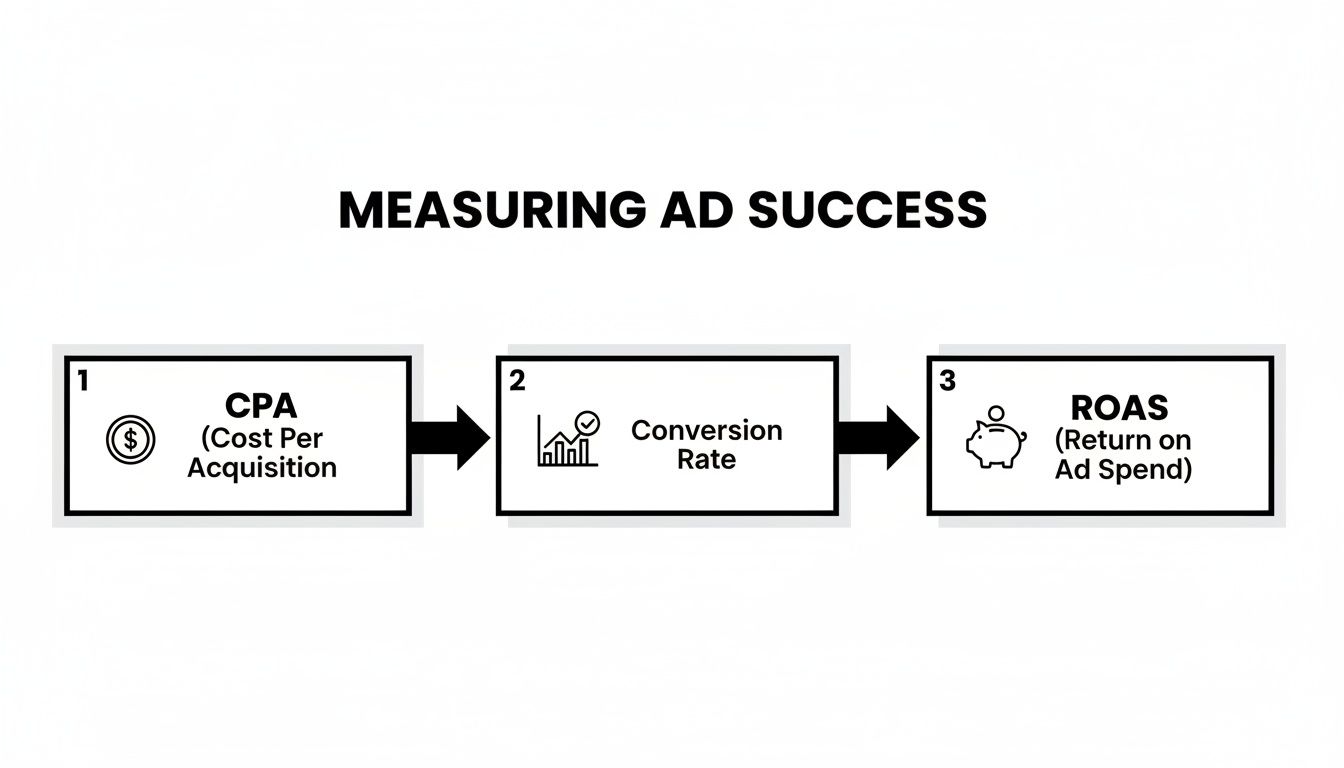
By keeping a close eye on your CPA, Conversion Rate, and ROAS, you'll quickly see which ads are winners and which are duds.
This is a continuous cycle. Kill the ads that are underperforming and pour more budget into the ones that are printing money. This data-driven approach is the engine that powers a truly unstoppable direct response machine.
Inspiring Examples of Direct Response Advertising
Theory is great, but seeing direct response advertising in the wild is where it all really clicks. The best way to get a feel for how the core pieces—the offer, the urgency, and the call-to-action—fit together is to pull apart campaigns that absolutely nailed it.
These examples, from totally different eras and channels, prove that the core principles just plain work. They weren't built for fuzzy "brand awareness"; they were engineered to make people pull out their wallets, right then and there.
The Classic Print Ad: David Ogilvy
Long before the internet, David Ogilvy was the undisputed king of direct response in print. His legendary ad for Rolls-Royce is a masterclass in using long-form copy to drive a very specific action.
The headline alone is iconic: "At 60 miles an hour the loudest noise in this new Rolls-Royce comes from the electric clock."
- The Offer: The ad sold more than a car; it offered a peek into a world of unmatched quality. The implied offer was a chance to join an exclusive club of people who appreciated the absolute best.
- The Urgency: No "buy now!" flashing buttons here. The urgency was subtle, built from pure desire. The incredibly detailed copy made you feel like you were missing out on the pinnacle of engineering by the second.
- The Call-to-Action: Ogilvy didn't leave you hanging. The ad ended with a clear invitation to write or call for a brochure or to book a test drive—a simple, low-risk next step.
The Modern Viral Video: Dollar Shave Club
Dollar Shave Club's launch video is the perfect example of direct response for the YouTube generation. They used humor and a dead-simple value prop to not only go viral but to build a massive subscription business almost overnight.
The video was pure entertainment, but it never lost sight of its goal: to sell.
The secret to Dollar Shave Club's explosion wasn't just funny jokes. It was an irresistible offer that solved a common, annoying problem in a smarter, cheaper way.
- The Offer: "Our Blades Are F***ing Great" for just $1 a month. It was simple, memorable, and immediately made you question why you were paying so much for razor cartridges.
- The Urgency: The direct, no-BS pitch made every other option seem ridiculously overpriced. The urgency was clear: switch now and stop wasting money.
- The Call-to-Action: The founder literally points at you and says, "Stop forgetting to buy your blades every month and start deciding where you’re going to stack all those dollar bills I’m saving you." The final shot? "DollarShaveClub.com." Impossible to miss.
The Trust-Driven Podcast Ad: HelloFresh
Podcasts are an incredibly intimate channel, and meal-kit company HelloFresh has used them to perfection. They lean on host-read ads to drive thousands of sign-ups, turning a loyal audience into paying customers.
When a host you trust tells you about their personal experience, it doesn't feel like an ad. It feels like a genuine recommendation from a friend.
- The Offer: A huge discount on your first few boxes, often pitched as "16 free meals" or another high-value, can't-miss deal.
- The Urgency: The offer is always tied to a unique promo code, like "PODCAST30." This not only helps them track where sales are coming from but also makes the deal feel exclusive and temporary. It’s for listeners only.
- The Call-to-Action: The host spells out the website and repeats the promo code multiple times. The instructions are crystal clear: "Go to HelloFresh.com and enter code PODCAST30 at checkout." They make it almost effortless to act on the impulse.
Got Questions About Direct Response? We've Got Answers.
Jumping into direct response can feel like learning a new language, especially when you're trying to see how it fits with everything else you're doing. Let's clear up a few of the most common questions that pop up.
How Do You Balance Direct Response With Brand Building?
So many marketers get this wrong, thinking it's an either/or battle between brand building and direct response. The truth is, they're two sides of the same coin and work best when you use them together.
Think of it this way: your brand is the reputation you build over time—it's the reason people trust you. Direct response is the specific invitation you send out asking them to take action right now. A strong brand makes every single direct response ad more powerful because that trust is already there.
The best strategy is to run both kinds of campaigns. Use brand ads to tell your story and stay top of mind, then hit them with a direct response ad to convert that warm fuzzy feeling into a sale, a lead, or a download. Just make sure your action-focused ads still sound like your brand.
What Are the Most Common Mistakes to Avoid?
The biggest blunders in direct response usually happen when people forget the fundamentals. If you can sidestep these common pitfalls, you’re already ahead of the game.
- A Vague Call-to-Action (CTA): If you don't tell people exactly what to do, they'll just keep scrolling. "Learn More" is weak. "Download Your Free Ebook Now" is a clear command they can follow.
- A Weak Offer: A bland discount or a generic freebie isn't enough to stop someone in their tracks. Your offer has to be so good it feels like a no-brainer.
- Ignoring the Data: The whole point of direct response is that it’s measurable. If you're not obsessively tracking your CPA and ROAS, you're just guessing with your budget.
Can Direct Response Work for High-Ticket Products?
Absolutely. It’s a common myth that direct response is only for cheap, impulse buys. It works incredibly well for high-ticket items like enterprise software, consulting services, or even cars. The only thing that changes is the goal of the ad.
For expensive products, the goal of a direct response ad isn't to get a "Buy Now" click. It's to generate a qualified lead by offering a valuable, low-risk action.
Instead of asking for a $5,000 commitment right away, your CTA becomes "Book a Free Demo," "Download Our Exclusive Case Study," or "Schedule a No-Obligation Call." You're using the ad to get high-intent prospects to raise their hands, pulling them into your funnel so you can nurture them toward the big sale.
How Has Digital Technology Changed Direct Response?
Technology didn't just change direct response—it put it on steroids. Back in the day, marketers had to rely on things like mail-in coupons and different 800-numbers to track what was working. Today, digital tools give us insane precision and speed.
We can now use hyper-targeted audience segmentation on social platforms, run A/B tests in real-time, and see performance metrics instantly. Tracking pixels let us build sophisticated retargeting campaigns to bring back cart abandoners or site visitors. This constant, immediate feedback loop means we can tweak and optimize our campaigns on the fly, making direct response more profitable than ever before.
Ready to create scroll-stopping social media content that drives immediate action? ViewPrinter provides an all-in-one platform with AI-powered tools to generate, edit, and schedule high-converting posts and UGC-style ads in minutes. Start building your next viral campaign today at viewprinter.tech.